A couple of months ago, I read a book which talked about the importance of paying closer attention to people. Many of you will have likely come across the notion that when we are in conversation with others, that we should be listening with the intention of understanding, not listening just so we can respond.
For the record, I struggle with this.
This particular book was called “Attention Pays” and if you’re in a service industry, it’s a recommended read. Hell, if you just want to have better relationships in general, it’s probably worth reading.
What it reminded me of was the fact that I am easily distracted. My mind moves at what seems like 100mph and I frequently feel like I need to write down mental notes throughout the day lest I forget something I need to do.
Here at RevFit, I have a laptop stand that is set up and historically, I would keep a laptop on there so I would have quick access to incoming emails and Facebook messages that may need immediate attention during the workday.
As a result of that quick access, I would drift back and forth to my laptop during client sessions just making sure I wasn’t missing anything. So, eyes on a computer meant eyes not on the clients. I was aware of it, but I wasn’t changing it.
The book reminded me to be more focused on what was happening in front of (and around) me. I took my laptop down and stuck it in my office so I was less inclined to be drawn back to that addictive cycle of constantly checking for updates.
By and large, the way the business operates is relatively seamless when all pieces are in motion: employee morale is up, client retention is great, and there aren’t a lot of things I can complain about.
But that doesn’t mean we (or I) don’t have room for improvement.
In this week’s article, I wanted to help you fine-tune areas you can improve on as well. There will be questions you might consider asking yourself and areas I wanted to offer some insight on.
The longer I’m in this business, the more I find that answering tough questions leads to better outcomes.
In the words of the late Maya Angelou, “Do the best you can until you know better. Then when you know better, do better.”
On Fitness
-By what do you measure your progress with fitness?
-Are you getting stronger?
-Are you getting faster?
-Is your recovery better from an intense workout?
-Are you more flexible?
-Do activities of daily living (chores, laundry, carrying groceries or going up a flight of stairs) get easier for you?
Not every aspect of fitness needs quantitative data. If you base improvement on how you feel or how you look, this is a great measuring point. Maybe you just need to know that you’re more active now than you used to be. Perhaps focusing on increasing your daily step count is a realistic and worthwhile goal. If you’re not sure that you’re improving, tracking with data (a log of sets, reps, weights, mileage, etc.) can be helpful.
Remember that improvements in fitness are not always linear. There will be times in life and in training where you will have to back off of intensity so that you can monitor recovery and make sure form is not suffering. Quality will always trump quantity when it comes to training.
On Diet
-Are you losing (or gaining) weight at the frequency that you’d like?
-Do you frequently change diet methods hoping that one will give faster results than another only to be disappointed and jump to something else?
-Do you often categorize foods as “good” or “bad” (not to be confused with trigger foods or foods you have an allergic reaction to)?
-Do you typically eat according to plan throughout the week and “throw caution to the wind” on the weekends undoing a week’s worth of progress?
-How often do you prep meals?
-How often do you frequent restaurants/fast food establishments?
-What percentage of your diet comes from liquid calories? (Think juice, energy drinks, alcohol, carbonated beverages, and any creamer you might use in coffee/tea).
-Have you ever used a food scale to accurately measure portions?
Similar to my thoughts and questions on fitness, not every aspect of food needs to be tracked. If you’re frustrated with the direction your scale is moving, short-term food tracking can be helpful. It’s important to note that just because a given diet worked well for you once upon a time does not mean it will work again to the same positive effect. Your lifestyle and demands on your time may have changed enough that the same “trick” can’t work twice.
Something that was helpful for my clients to utilize during the pandemic when we were focusing on social distancing and not doing up-close body measurements was to look at the diet from the “outside in”. In other words, write down the foods you eat (without judgment) and see if anything strikes you as unnecessary or counterproductive. Many clients found that they snacked to frequently, grazed on their children’s food too often or consumed a great number of calories after dinner. These are easy places to fix without counting calories and still see positive results.
On Mental Health
-Do you currently take medication for depression?
-Do you currently take medication for anxiety?
-Did you notice any change in weight gain after starting your medications?
-Have you spoken to your doctor about “weight neutral” medications which can help with neurological challenges and also not impede weight loss goals?
-Do you currently have a therapist?
-Do you frequently use exercise or food to manage stress, depression or anxiety?
-Have you spoken with a professional to help you develop healthy coping mechanisms if food or exercise are not positively helping you?
-On a scale of 0 to 10 (zero being not noticeable and ten being intolerable), where do you measure stress in your life? How are you responding to that stress?
One of the best things I’ve done for myself in the last couple of years was go back to therapy after many years away from it. I often told myself that my problems were solved and that I could handle most anything on my own. I was wrong. I need an unbiased sounding board to help me sort through many of my thoughts. I found a therapist who filled a certain paternal void and has been a grounding point when my mind feels at its most chaotic. You don’t have to go to therapy just because things are going poorly in your life. Therapy can still be tremendously helpful even when life seems to be on an upswing.
On Work
-Do you have a fulfilling job?
-Do you enjoy the people you work with and for?
-If you don’t “love” your job, does the job that you perform allow you to do the things you love outside of work?
-Do you frequently “take work home with you”? Or, does work stay at work?
-What would you be doing with your time if you weren’t working?
-What do you do to continue to perform at your highest level as an employee at your job?
-If you are a business owner, how do you know you’re getting better at your job aside from seeing an increase in revenue?
-What continuing education would be most helpful to you right now?
I’m very blessed to say that I have a fulfilling job and one that I love. I am proud of my staff and proud of my clients. I do work long hours and it does take a physical toll but I am able to look back on each day and know I did some good in the world. I am always looking for ways to stretch my abilities and get better at what I do. I know I may never be the best but I also know I’ve come a long way and will continue to improve as a coach, a business owner and in grooming my staff to be the best they can be as well.
On Intimate Relationships
-Are you married (or in a long-term relationship)? If so, how many years?
-Would you say that this relationship is currently in a good place?
-How can YOU be better for your partner?
-What ONE thing would make your partner happy that you could do right now?
-When was the last time you had a getaway/vacation with your partner?
-Have you considered couples therapy to see how you and your partner can be your best for one another?
-When your partner says they support your health goals, is that sincere or is it lip service?
-How can your partner support your health goals better? Do they know?
I’ve been with my wife for nearly 12 years, married for almost 7 of it. She is my second wife and I learned a lot about myself (not all good things) from my first marriage. Marissa and I have been through a lot together: many wonderful awe-inspiring things and many damaging, traumatic events as well. I can say, without question, we are in the best years of our marriage now. Some of that took therapy and some took just learning how to listen and respond to each other in better ways. Focusing on having a better relationship between the two of us has the added bonus of making us better parents as well.
Case in point, our son Sebastian (below) being always inspired by coming to the gym with his Mom 3 days a week, he gets better, we get better, everyone wins.
For you: take stock of these questions and take time in answering them. You deserve to improve, you deserve to win, you deserve to get better, to BE better.
I’m honored to welcome back someone who almost needs no introduction on this show as she’s been on four times previously, Dr. Lisa Lewis. You can reference Episodes 157 (with her husband, Tony Gentilcore), 189, 227 and 238 for our previous conversations together. Dr. Lisa has been kind enough to join me for the next 4-part series and in this first episode, we discuss a strengths based approach in both training and life. We talk about negativity bias, leveraging our strengths and how to interpret our weaknesses or opposing challenges within perspective of what we’re best at and much more.
Like most households, we have to routinely rummage through our pantry, fridge and freezer to reorganize the items we use the most and separate them from things that have been shifted around over time.
Because Marissa and I both handle cooking duties in the home (she cooks throughout the week and I tend to cook on the weekends), there are the things we frequently use as well as snacks for Sebastian and Jackson, baking staples and other odds and ends.
Ultimately, we come across things that are no longer fresh or are clearly expired and need to be discarded of.
This, in turn, leads us into conversation about what we might be cooking over the next few days and what we may need to get from the grocery store on our next trips.
Of course, like a good “spring cleaning” can do, when you remove the clutter, you can look at things with a fresh set of eyes and see what you’re working with (and. conversely, what’s no longer working).
On that note, I wanted to write this week’s article keeping in mind the readers who are trying to self-correct and get their own food environment to a place that makes sense for them.
Is It Time For A Purge? Take some time (30-60 minutes) to remove any foods from the countertop, fridge, freezer, and pantry that you no longer need. This may be expired foods or foods that are counterproductive to your current diet goals. I have certain trigger foods (foods that I can’t moderate the intake of) and Marissa has hers. Periodically, we’ll remind each other what those foods are and every so often, some new snack food appears and we’ll have to make mention: “Oh yeah, I definitely can’t have that in the house right now.” Point noted and that’s typically all it takes to clear the air of problematic foods.
But Our Kids Eat That… This is a sensitive one. For the most part, the foods that Sebastian eats (for instance) are not foods that rank high in desirability for Marissa and I. However, like most kids, Sebastian likes chicken nuggets, mac and cheese, pretzels, crackers, etc. Since Marissa is normally the one buying the things that Sebastian eats, she’ll buy variations or brands that are less appealing to her to minimize snacking or grazing on those foods. We try to watch the verbiage we use around Sebastian so that we are less inclined to label foods as good or bad. We might define a food as a treat which could be something that’s eaten after a meal or a special occasion. Ice cream and cookies aren’t frequently in our house (Marissa is lactose-intolerant and cookies are one of my “impossible to moderate” foods).
Research “Easy” Recipes. I taught myself how to cook using Scott Baptie’s excellent High Protein Handbook series right after Sebastian was born (he just turned 4.) I also took a few cooking classes with a friend who used to teach them in the area so I could learn better practices with my knife and some basic prep skills. Since then, I’ve learned what recipes I’m good at and I will frequently turn to Google to look up “easy” or “quick” options for making dinner. For instance, Marissa and I both love Asian and Indian cuisine. So, if I’m cooking, I’ll think about my protein base and look up options that coincide with it i.e. “easy Indian chicken recipe” or “easy Asian pork recipe”. Most easy options have short prep time and don’t take long to cook. To save on time and frustration, I’ll chop up my veggies, garlic, meat, etc. so that cooking moves more efficiently and I’ll set aside the measured portions of my spices. Neither of us care for onions and fortunately, almost any recipe can have onions removed and still taste delicious.
Get Curious About Spices If you haven’t used a spice in a while (or ever) look up recipes that include it. As referenced above, Indian recipes frequently use a wide range of delicious, aromatic spices like turmeric, cardamom, coriander and garlic. If you’re not a fan of a certain cuisine, search recipes that include a spice. For instance, typing up “chicken recipes with coriander” into Google can lead you down a cool path of options so that you can cook “outside the box”.
Simple Carb Strategies Neither Marissa nor I are low carb dieters and I generally will eat higher carb than she will to fuel a comparatively more active day. However, one thing that makes cooking at night easy and helps us control caloric intake without calorie tracking is to generally go low-carb at night. We’ll find a protein base (seafood, poultry or beef) and build our vegetable around it. I mentioned above that we both like Asian and Indian cuisine and both of those feature dishes built around rice. We opt for cauliflower rice as a substitute to reduce overall calories, increase our vegetable intake and add more fiber to the diet. I won’t try to convince you that cauliflower rice and regular rice taste the same. They don’t. But, if you’ve got your broth/sauce and the rest of your dish topping the cauliflower, it’s an easy low carb/calorie substitution to make.
Measure Your Alcohol Most of my clients come to me for fat loss and most of those same clients like to partake in an alcoholic beverage. I wrote a much lengthier article about this awhile back but since alcohol is an easy thing to overdo, start measuring your intake. Marissa and I are almost exclusively bourbon/rye/whiskey drinkers and I will normally post our dinner and drink selection each evening on social media. Our alcohol is always measured and helps us stay on top of something that might otherwise be difficult to moderate if we just left it to eyeball portions.
Eating Out Is Infrequent I’ll make the comparison between my wife and I. Marissa normally eats 2 meals a day, something light in the morning and then a normal sized dinner (for her needs). That’s 14 meals in a week. Of that 14, she might have 1-2 meals at a restaurant. This is for a few reasons: 1) She has difficulty guesstimating the calories she’s consuming at a restaurant unless it’s listed 2) Most restaurants use butter in cooking and that messes with her digestive system 3) She generally feels better when she’s in control of what’s going in her body. Marissa found an approach which works for her and helped her lose about 35 pounds. By comparison, I eat 3-4 meals a day (21-28 meals in a week) and 5 of them are at a restaurant. I will typically eat out during a work week around my lunch break. I am a creature of habit so I tend to float between the same handful of restaurants and order the same basic thing: it’s predictable and doesn’t take a lot of brain power. Consider yourself in these equations. If you’re eating out more than 20% of the time and you’re struggling with your fat loss goals, think about some of the approaches I referenced above. It’s not impossible to lose weight when you’re at the mercy of restaurants but it is significantly more difficult.
If you read something of value in this article, please feel free to share it on social.
In our final episode of our 4-part series together, Dr. Allan and I go a slightly different route with our content to focus more on training this week. In this episode, we discuss considerations for training depending on the goals of the individual. Dr. Allan breaks down training sequences for the strength athlete versus a focus on maximizing hypertrophy. We also break down our thoughts on frequency, volume and considerations around injuries.
In the early 2000s, I was midway through my decade of drug addiction. I was dating the woman who I would eventually marry and would become Jackson’s mother. We were in New Jersey attending a convention for Beatles fans and while we were standing in line, we would talk to other fans who had their own areas of collecting related to Beatles memorabilia.
One fan collected as many of the first print books that had been written about the Fab Four and, where possible, would get those first print books signed by the author(s). Another fan collected original posters and promotional material. Then we ventured upon a gentleman who said: “I collect everything. Everything I can get my hands on.”
That sounded more in line with what I was about, too. Just buy it all.
It’s a funny thing, collecting Beatles memorabilia. At the time, the band themselves hadn’t been a functioning unit in roughly three decades and most of the more valuable items would have come from the 60s when they were still recording, touring, etc.
The problem was (and likely still is) that if you bought Beatles memorabilia in the 60s, you were going to play it, read it, store it in places it was never meant to be stored and, as you can imagine, ruin the overall quality of the piece. It stands to reason that finding 60s era Beatles items in mint condition is quite the rarity.
So, for someone like me who was just cutting his teeth on a collection, I bought whatever I could, wherever I could, and hoped that what I had actually held some value.
Shamefully, I admit that I paid for most of my collection with money I made from selling drugs.
By this time, my addiction was well rooted and even though I always managed to hold down a full-time job, that job normally covered the cost of rent, my car, my utilities and little else. If I wanted to consume more drugs, I had to sell more drugs. And if I wanted a lavish Beatles collection, that same drug money afforded me the luxury.
At the time, it was fun. I’ve collected things as long as I can remember and getting my hands on Beatles items of any variety was a way to feed into that incessant need for more.
However, when I got clean, the collection didn’t mean as much to me. And the more distance I put between myself and drugs, the less I wanted to look at it, enjoy and appreciate that collection.
So, I sold off nearly all of it at a fraction of what I spent for it.
I reached a point where every time I looked at all of the things I owned related to that band, it gave me nothing but negative feelings. I knew where the money came from and I knew what dishonest, disingenuous and unsavory things I had to do to buy those items.
The only way I could get rid of that feeling, was to get rid of those pieces.
Getting off drugs solved only certain problems in my life. I had more money, which was nice and I had more mental clarity, which was also nice. But I had done a fair amount of damage to my body from all those years of drugs and I needed to start rebuilding a body and mind that had seen better days.
In addition, being clean meant that I had to start facing a lot of the demons I had tried to smoke, snort, drop and hallucinate myself away from. Like a lot of things in life, if you keep sweeping your problems under the rug, you don’t get rid of the problems, you just have a bigger mess to clean up at a later date.
I share this story and offer a statement from my friend and fellow coach, Dr. Brad Dieter: “You’ll never be able to go back to your old habits and be a new person.”
When I coach change for my clients, many people think that they can continue to cling to most of who they are (and often, who they were) and get these magical results.
That’s rarely the reality, though.
If you want fat loss, you generally have to create significant change. This is why the notions of “eat less, move more” and “lifestyle change” are correct but vastly over-simplified.
Much like I had to do with my drug use and my completely obnoxious Beatles collection, you have to be willing to shed some skin and leave the “former you” well behind.
Please don’t read what I’m not writing. If you’re a good, trustworthy, reliable person in most areas of your life, that doesn’t need to change. You can be all of those things and still have a really shitty way of handling the times of your life that are more stressful, more chaotic and less predictable than you’d like.
The fact of the matter is, I was a drug addict because I didn’t have good coping skills for stress in my life.
Here are some things I’d like you to consider:
–How do I react to stress? If the first thing you do when times get hard is raid the pantry, the fridge or drown your woes in a bottle, that’s a sign that something needs to change. Altering your environment can be a huge step because if you remove temptation from the home, you’re less likely to have that default reaction. It might also help to have a list of things that you enjoy doing that are also stress relievers so that, when the time comes, you can start choosing different outlets.
–Consider an If/Then approach. As an extension of what I referenced above about alternative outlets for stress, start crafting “if/then” solutions for your life. This will take some effort on your end. I’ll use dining at a restaurant as an example. Let’s assume that you’re trying to adhere to a diet plan and your family wants to go to an Italian restaurant, typically a place where you’re more inclined to overindulge.
One example would be:
“If” I go to an Italian restaurant, “then” I’ll order a grilled chicken salad with dressing on the side and light cheese.
Or
“If” I go to an Italian restaurant, “then” I’ll ask the server to refrain from bringing bread as an appetizer and to box up half of my meal so that I eat a smaller portion than normal and can save the rest for another meal.
You’ll have to consider the examples that would be more appropriate to your life and your current obstacles.
–The person you were is not the person you’ve become. I frequently hear clients who are well into their 40s, 50s and 60s share stories with me about the type of training they did in their 20s and the type of diet they succeeded with before they ever had children. Those stories are all fine and good but they are rarely helpful when you consider that everything about that person’s life has changed over the decades. The body doesn’t respond the same because the mind is not the same, the responsibilities are not the same and there may be injuries to consider that weren’t a concern 30 years ago. I can’t train my body the same way at 45 as I did at 25 despite the fact that I’m otherwise healthy and at a reasonable weight for my liking. Clinging to a former you doesn’t appropriately serve who you are now.
–Change is painful. I recently read a book that shared the sentiment: Pain is mandatory, suffering is optional. (Apologies for not remembering who to credit that to). If you need to change your body to get stronger or you need to change your diet to get any degree leaner, it will be profoundly uncomfortable. This is not synonymous with impossible and it doesn’t equate to “no pain, no gain”. However, we (as people) generally don’t like discomfort. We like pleasant things, we like fun things, we like things that make us feel good. By and large, the things that matter most to us: a stable job, a functional marriage (or long term relationship), a better moving body or even a lasting friendship require work and will often have moments of stress and friction. Accept that discomfort and be willing to sit with it. Not every negative feeling or uncomfortable circumstance needs to be numbed or avoided.
–Shed the skin. My fellow addicts know that we will always be addicts (albeit with different vices). This has to be managed in as realistic a manner as possible. That being said, the man I was in my 20s is dead and I have removed nearly all signs of him from my life. I’ve replaced that man with someone who is generally more responsible, healthier, and better for all those around me. I’m far from perfect and what I can’t fix on my own has taken therapy to help with. Akin to what my friend, Dr. Dieter said, I can’t go back to that person and have or deserve all the good things in my life today. It was skin I had to shed, a persona that no longer served a greater good in my life and my only regret, is the people I hurt back then. You may have some skin to shed as well if you want a different life than the one you’re current living. Famed professor Joseph Campbell is known for a quote that is similar to the sentiments I’ve shared above: We must let go of the life we have planned, so as to accept the one that is waiting for us.
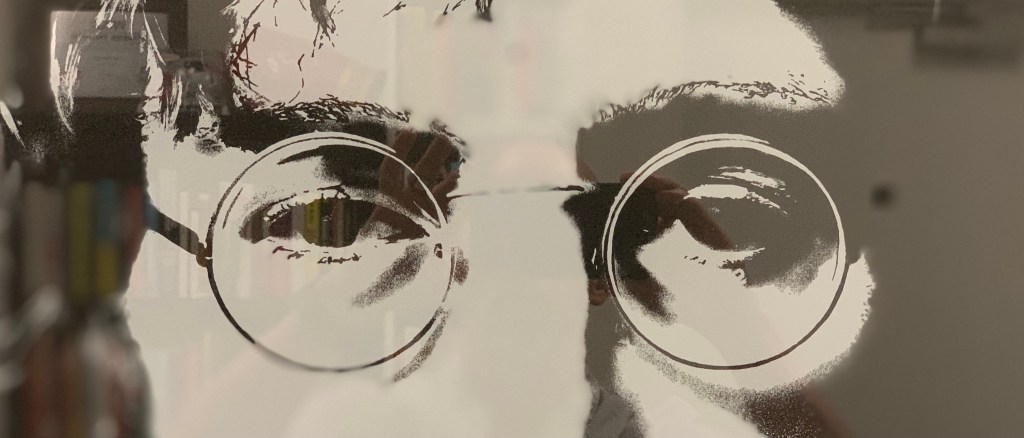
Pictured below is one of my only remaining pieces from my original collection, a piece of artwork from a Lennon art exhibit that now hangs in my office at the Rev. I paid for this with drug money too and while I probably could get rid of it, I think I swept away most of the negative sentiments from that collection. This is a reminder of how far I’ve come and that change was not only difficult but necessary.
I had to establish enough self-worth to remind myself of that.
In Part 3 of our 4-part series together, Dr. Allan Bacon and I continue our conversations in fat loss by tailoring this episode to emotional eating and overcoming cravings. Just like the first two episodes in this series, there’s a lot to soak in within a relatively short time so you may want to listen back to this one more than once.
I was sitting at my desk in my first location of RevFit when you called me. As memory serves, you were driving back to work after leaving the doctor’s office.
“Are you busy?”, you asked.
“No, I’m just sitting here in the office at work. What’s going on?”
“Well, I just left the doctor’s office. They told me I have multiple myeloma.”
And I did what any person would (and oftentimes shouldn’t) do, I got on Google to look it up as I hear your voice on the phone.
“It’s bone marrow cancer,” you said. “Which would explain why I’ve been having all of this pain in my hips and why I haven’t been recovering from the carpal tunnal surgery the way I would have normally.”
I saw the symptoms and I read the prognosis. Neither of which were positive.
“Dad, this isn’t good.”
“I know. Don’t tell your mother yet. She’s at work and I don’t want to bother her with this until she’s done working.”
“Ok, but what are you going to do?”
“Well, we’ll have to talk to a few more doctors who specialize in this type of cancer and see how they want to treat it.”
You were ever the optimist and you continued to hold out hope that we had the right doctors to help and the right course of action to treat the cancer.
The hope was that you would have stem cell procedures done that would give you more time.
But nine more months was all there would be. None of the protocols the doctors used would save you.
You passed in the evening of March 23 of 2011. Coincidentally, it was on Gram’s birthday, just a few weeks before Mom’s birthday and well before you’d turn 60.
You would be turning 70 this week.
Each year, as I write things about you (normally around the anniversary of your passing or your birthday), I have to dig deep: one, to remember circumstances and write about them so that I don’t forget and can keep them for posterity and two, to work through the emotions of losing someone who meant so much to me (and Mom).
I wanted to approach this article from a slightly different place.
As I’ve watched Mom get older each year, with her own set of health challenges, it’s hard not to consider what you would be like had you lived.
I know, and I believe, that your personality would not have changed. You would have been the same kind, compassionate, loving father, husband, father-in-law, grandfather and brother that you had always been.
I believe you would have retired from Goodyear, where you worked for all of my life and where you were employed up until your passing.
However, I don’t know that you would have been able to just be a retiree. You would have needed things to stimulate your mind, things that could occupy your time and give you a sense of accomplishment and productivity. I believe I got those attributes in equal measure from you and from Mom.
You would have remained in awe and admiration of your grandsons: Jackson and Sebastian. Likewise, you would have loved to see what Mom has accomplished with Savoir-Faire Event Planning and what I’ve been so fortunate to do with RevFit.
I believe you would have maintained the weight I helped you lose when I moved back here to start this business. I remember how good you said that you felt and it was one of my proudest moments ever as a coach to help you lose that weight.
I think you would have been a constant reminder of the type of husband I should be. This year will mark 47 years that you and Mom would be married. No one has ever or will ever love Mom the way you did. Believe me when I tell you that she knows that too.
I think you’d still enjoy watching car races on television, you’d still love being on a boat, you’d still love the beach and maybe I’d get you to join Marissa and I for bourbon from time to time (you know, beyond the Jack and Coke you would have every so often).
Much of what I’ve written about you since you passed has been from a place of sadness and emptiness. I can’t ever fill those holes. I wanted to write something that didn’t reduce me to tears this time. I wanted to think (or wish) about you being here, being full of life, being everything that you’ve missed out on over the last 10+ years.
Selfishly, I wish I could see you celebrate 70 years with us. I’d like your grandsons to be there to see it. Turns out, I may have been the first American born under our name but the onus is on Sebastian now to carry it further.
I’ve never been more proud than now to be your son and maybe, just maybe, after nearly 46 years on this earth, I might be fulfilling the man you wanted me to be.
Happy Birthday, Dad. Play a song up there for us, okay?
Dr. Allan Bacon and I are back this week in Part 2 of our 4-Part series together. In this episode, we talk about expectations around hunger and how to manage it, as well as the criticism and influence someone might be subject to while dieting and what to expect from our body’s responses to dieting while doing so. Just like our first episode in this series, this episode is full of insight and Dr. Allan has a ton of information to help.
Several years ago, I was working with a weight loss client (Hi, J!) and when he started he didn’t see a great deal of fat loss success.
Of course, during our initial consultation, I would have spoken with him about his current eating behaviors, potential calorie goals to shoot for and some thoughts on how exercise and food would work together to help him succeed.
However, not everyone uses those tools at the beginning and sometimes throughout our working relationship, we have to revisit things we spoke about early on.
One day, J came in and said: “Hey, by the way, I’m down eight pounds.”
“No kidding?” I asked, “What changed?”
“Well, I cut out potatoes.”
If you don’t know me, I have a terrible poker face and I’m not sure I did a very good job of hiding my surprise or opportunity to make a sarcastic comment. I did manage to ask: “Do you typically eat a lot of potatoes?”
“Oh yes,” he replied. “You know, hash browns for breakfast, chips or fries with a sandwich at lunch and mashed potatoes or a baked potato at dinner.”
*wellillbedamned*
In J’s case, he not only made a sweeping change to his diet, he found one area where abundance occurred, stripped it away completely and dropped a good chunk of weight.
One point of interest was that, J didn’t reference all of the potato consumption during our initial consult. If he had, it might have sparked an avenue to travel to make some small changes and see more immediate results on the scale.
And J wouldn’t be alone in that regard.
It’s not uncommon for a potential client to not completely unveil what their diet looks like in reality during a consult. Sometimes, they simply forget and sometimes, an individual might feel some degree of shame or embarrassment that a certain food (or behavior) is in greater abundance than they care to admit.
It’s not just food either, clients might not mention how much they drink, how poorly they sleep or even remember all of the pre-existing injuries they may have before getting started with an exercise regimen.
Part of this is just human nature. If we don’t meticulously track our food intake, it’s easy to forget what our “normal” is. This is similar to how it might be difficult to say how many drafts and charges occur in our bank accounts when we don’t look at our statements regularly.
On another occasion, I was working with a gentleman who ate “pretty well” but wasn’t seeing the scale move. We got on the subject of what he drank throughout the day and he remarked that he drank a low calorie drink.
“Which one would that be?” I asked.
“Oh, I drink the Arnold Palmer Lite from Arizona. I love that stuff. I’m so glad it’s low in calories.”
I looked up the drink he referenced and each serving size (12 oz) was 80 calories.
“That looks good,” I said, “How much of it do you drink?”
“I can finish a jug of it every couple of days…” he replied.
One jug, at 12 oz per serving, was 880 calories. So, he was consuming approximately 400+ calories per day with his “Lite” drink. Once we brought that to his attention, he switched to unsweetened tea with some lemon and diet ginger ale and the scale started moving the direction that he wanted.
While on the subject of liquid calories, I was working with a woman once who could give me the calorie breakdown of every meal and snack she consumed. Every food selection was “healthy”, minimally processed, and practical for her busy lifestyle. She was within an appropriate calorie range where she should have seen weight loss occur. I asked her what she drank each day.
“Water and a lot of coffee.” she said.
“Ok, cool, is the coffee black?” I asked.
“No, I put some low calorie creamer and a little bit of sugar in it.”
“Have you tried measuring those?” I asked her.
“No, never. I just eyeball it.”
I told her to try measuring the creamer and the sugar on the next day.
Her rough approximation: over 500 calories (throughout the course of the day) from her “low calorie” creamer and her sugar. They certainly add up!
“The tale of the potato” isn’t uncommon and while the potato was J’s area of abundance, for someone else it’s snacking, or it’s liquid calories (creamers, juices, alcohol), or it’s added fats (cooking with oils, avocado on toast, nut butters, nuts).
Look for the areas that appear in abundance in your diet. Keep a skeptical eye.
As always: the details matter.
*Coach Sebastian below modeling a good-sized potato.*





 Jason Leenaarts