Author: jleenaarts

  • Pain Makes You Beautiful

    “The title of this post was inspired by the Judybats song of the same name.”

    I’ve been certified as a personal trainer for nearly nine years. I’ve been involved in the fitness industry and given fitness advice to people for about seventeen years. Much of that initial advice was given well before I had much of a clue what I was telling people. Having always had a smaller frame and build, there were frequently people at a gym who would ask me what I was eating and how I was training to keep a certain physique. When I realized that I enjoyed fitness but wanted more of a foundation in having an idea what to tell people, I decided to get certified as a personal trainer.

    Within weeks of getting certified, I tore my rotator cuff performing an exercise that I was very accustomed to doing, at a weight that was not uncommon for me. Mind you, I didn’t know that I did anything particularly wrong. I felt a pain and did what a lot of people do: I continued to “work through” it. That “work through” caused more damage to the already injured area and it forced me to take a break from the gym, get some physical therapy, rest, and eat more painkillers than I probably needed to.

    After about six months, I was able to get back to my workouts again. Not a great way to celebrate being certified! Over the years, I’ve continued to experiment with different workouts and training philosophies in efforts to find a method that worked best to my benefit. I didn’t start lifting weights with any seriousness until my mid-20s so in some ways, I feel like I may have missed some great opportunities to do more for my body.

    There really haven’t been any other major issues with injuries until I started to push myself with my traplift last year. I was aiming for 3 times my body weight. For perspective, my weight has hovered between 135-140lbs for the last several years. So, that was leading me to a 405lb personal record that I was gradually scaling up to. Once I got myself past 300lbs, every new record just felt “heavy.” It was a relative term. One day, I was shooting for a personal best of 370lbs for 3 reps. I hit the set, but it was hard. My back was pretty fired up but not really any more or less than on previous record-setting days. However, I made the mistake of bending over and rotating slightly to remove one of the plates from the bar and my back seized up. I have never felt anything like it.

    About 20 minutes later, I was having trouble walking. There was a pain that started at my lower back and went into my glutes and leg. I was terrified that I had done something very wrong to myself and fear started to set in, “What if I can’t do my job??”

    I have had the luxury of knowing an amazing chiropractor and sports medicine doctor in the area. He got me in immediately and confirmed what I was already feeling: “Your back is really fired up right now and we need to get it calmed down.” He also added, “I know you pulled 370lbs today. I’m not sure I want to see you pull 380lbs.” Point taken. If this was the result of my ego getting the best of me, I wasn’t confident I would be able to perform the lift ever again.

    After about a week of hobbling around and babying my back, I was starting to feel normal. No herniated disc or permanent damage. But I started to think about what went wrong during the lift. Did my form go bad? Were my breathing and bracing mechanics out of sync?

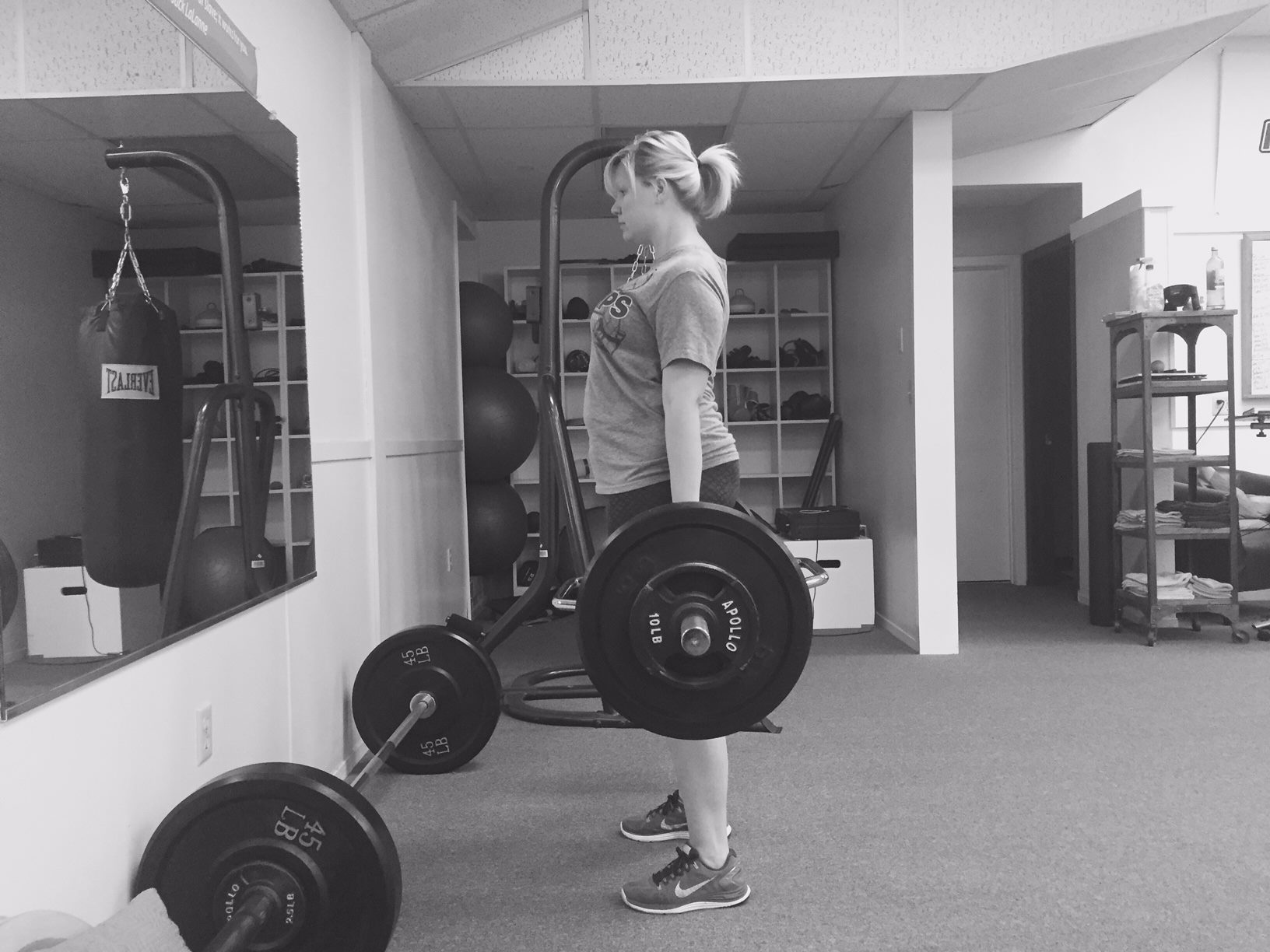
    So, back to the drawing board I went. I would continue to work on the things that could have gone wrong. Over time, I started to play with the lift again but at a much lower weight. I allowed myself to just get into the movement pattern, work on breathing, bracing and perfecting form. I also gravitated back to the traditional deadlift. For those who don’t know the difference, a traplift is a a deadlift variation where the weight is loaded evenly on each side of the body as opposed to being loaded in front of the body. For many people, the traplift is considered a “safer” alternative for those looking to pull considerable weight off the floor.

    Here’s a shot of me at starting position for a traplift, note where the weight is distributed in relation to where my body is.

    FullSizeRender (7)

    For comparison, here I am at starting position for a traditional deadlift.

    FullSizeRender (8)

    A few months ago, I was pulling a deadlift at 180lbs. Mid-way through the set, my back seized and it sent me straight to the floor. This was pain far beyond what I had experienced a year prior and I was moving 50% less weight! So, back to my favorite sports med doc I went. This time, he and I had a far different conversation. Fortunately, still no disc herniation but I was in much greater pain and had so much difficulty walking or sitting for the first three days, I had trouble imagining relief.

    This was the point where my doctor, an avid weight-lifter and strength enthusiast himself, said “You may need to consider that you might not be best suited for this lift.” It was another blow to the ego but I knew I had one of two options: 1) Ignore the advice, feed my ego, and risk not only another injury but compromise my ability to do my work OR 2) Find alternative ways to lift so I can still be active and productive.

    I love lifting weights. I’m not a big guy and I have no visions of competing in powerlifting meets or anything of the sort. But I love feeling strong. However, I’m not getting younger either. I try to suffer few illusions of looking like anyone on the cover of a fitness magazine.

    But I do need to highlight something else as well: lifting weights, exercising, being active in any way bring a risk of injury. That risk is real and the likelihood of me having a lifetime of fitness will carry it’s share of injuries along the way. My best hope is to keep my injury rate as low as possible throughout my life.

    What I have noticed after years in this industry is, injuries like these, while horribly unfortunate and a complete inconvenience are not very uncommon with fitness professionals. I network with many of them around the world and at some point, we all have a horror story to share. The difference is, who decides to keep performing the problematic lift and who decides to move on to other options.

    I should also mention the fact that with all three of the aforementioned injuries, I was training alone. No spotter, no one to tell me where something may have looked “off” before the lift began. Do you need a spotter or a trainer for everything you do in the gym? No. But if you’re trying to tackle some of the accomplishments I was going for, relative to where you are now, it might help to have another set of eyes on you to make sure everything is moving the right way.

    Frequently, I’ll have clients come in who are dealing with one injury or another. Because many of us want to appear tough enough to handle our pains, the typical response is to “work through”that vulnerability. I would encourage you to heed my advice in being extremely cautious and conservative with that tactic.

    As I have had to take stock with where I want my training to be and what tools I have at my disposal to get me there, I’ve found it is far more important to work around pain than to work through it. If I could never do another deadlift or traplift again, could I still get strong and do good things with my back-dominant workouts? 110% yes.

    The biggest takeaway I want you to have from this post is to realize that working through pain is rarely ever a good idea. Leave your ego at the door and stay conscious of keeping your form appropriate for every lift, heavy or not. If you need a spotter, make sure you have one who knows what to look for when form breaks down. Contrary to the title of this article, which was inspired by a little gem of a song from a fairly unknown 90’s band, pain probably won’t make you beautiful but you can sure learn a lot about your limits if you succumb to it.

    Train responsibly, make progress, and be fresh for your workouts. The results will speak for themselves.


  • Revolutionary You! #25-Why Is Change So Hard? With Dr. Mary Malek

    Dr. Mary Malek joins me this week to discuss a struggle that so many people have: making change permanent. We talk about the issues and beliefs that can keep us rooted in following the same unproductive behaviors and how to solve them. Dr. Mary has so many amazing things to say from not only her background and practice as a clinical psychologist but as someone who has had to adapt to her own health issues throughout her life to establish a foundation of lasting, healthy change. This is an awesome discussion! To connect with Dr. Malek, you can find out more about her atwww.drmjmalek.com To find out more about your host, please visitwww.jasonleenaarts.com Download, subscribe, share with your friends and leave us a review to let us know how we’re doing!

    iTunes OR Stitcher

    revolutionary-you


  • The A$$hole Problem

    So many things get in the way of progress. Crazy work schedule, unreasonable demands on our time, conference calls that last longer than they ever should to accomplish less than you ever anticipated, etc. Time and again, I have found the biggest obstacle on our path to progress is ourselves. The self deprecation, badmouthing, sabotage and self-shaming is unfathomable. One of the best analogies I’ve heard is: Would you let someone talk to your child like that? Would you let someone treat your parent that way?

    People on a journey of weight loss have the unenviable position of being both the abuser and the abused. You do the damage to yourself (emotionally and physically) and you fall victim to every punishable deed. When did you become such an asshole to yourself?

    9enxc9

    I don’t like to play the blame game. Yes, bad things happen to good people. Yes, incidents in our childhood can affect us well into adulthood. I have been there, I  do understand.

    I also understand that if you’re reading this, you are a grown adult. You have big boy/big girl responsibilities. You can handle being held accountable. You carry the world on your shoulders. Life gets unbearable and quickly spirals out of control when all you really crave is control.

    But I’d like you to consider a perspective. Maybe the problem isn’t the diet that you’re on. Maybe the diet is okay and if you work it consistently, you will see results. Maybe the problem isn’t the exercise program that you’re trying (or still deciding to try.) Maybe the program is completely adequate and you just need to show up and get the time in.

    Maybe the problem is just you. You treat yourself like garbage and you hold yourself to standards that no one can live up to. This doesn’t mean you’re broken. You’re not. I promise. And you’re not a failure. You’re great.

    No one ever got to the place they wanted to be by being an asshole to the only person who can control the change. Ourselves. Not our spouses, not our children, our bosses, our colleagues. Just you.

    So, give yourself permission to fail. Permission to be less than perfect and permission to live a life that allows mistakes, detours, and a cookie.

    Look yourself in the mirror and say (out loud) “I’m done being an asshole.”

    You deserve better. You’ve “earned” better. It’s not about entitlement. It’s about taking your life back. The choice is yours.

    FullSizeRender (13)

  • Revolutionary You! #24-A Deeper View of Corporate Wellness With Greg Justice

    It took a bit to nail the time down because this week’s guest is in such high demand! I am honored to share the episode with a fitness legend, Greg Justice. Over the last 30 years, Greg has not only helped to light the way for others in the fitness industry to survive and thrive but he arguably pioneered the most successful way to implement corporate wellness initiatives on a national and international level. This isn’t just insight for other personal trainers though. Greg shares tips for listeners who want to see corporate wellness and health programs work for their own place of work. Greg is a bestselling author (check his Author page on Amazon) and you can also find out more about him and his incredible career at www.gregjustice.com To learn more about your host, please visit www.jasonleenaarts.com


    iTunes OR Stitcher

    revolutionary-you

  • Stupid Calories

    Fahad and I were talking yesterday about why he’s not been seeing his weight drop at a satisfactory rate. There are always so many sides to this conversation and it is important to me that I try my very best to meet any individual where they are on a spectrum of understanding what is happening. While there is a science to everything regarding weight loss, I hate speaking in scientific terms. It just isn’t my m.o.

    However, any of my clients deserve every ounce of information I can give them if they aren’t seeing weight loss at a “normal” rate. Fahad’s no dummy either. He “gets it.” But there is still a gap that has to be bridged. So, I asked him to walk me further into what his diet looked like.

    diet

    Actually, Fahad’s diet is nothing like that. He seems to eat very responsibly but as we’re about to see, maybe not totally in line with his goals.

    A typical day looks something like this:

    Morning meal: 1 pita bread with a few smears of cream cheese (approx 250-400 calories)

    Snack: Handful almonds or sunflower seeds (approx 200-300 calories)

    Lunch: Salad with beets, peppers, potatoes, lettuce, olive oil, herbs, spices (approx 300-400 calories)

    Snack: Starbucks pumpkin bread (approx 400 calories)

    Dinner: Meat/fish with steamed rice and olive oil (approx 400-500 calories)

    First, let’s discuss Fahad’s caloric needs. Based on his current weight, height, level of activity, age, gender, etc. His baseline calories (what he needs just to feel good where he is right now) is about 2000 calories a day. I normally suggest a reasonable deficit of 20% in calories. So, let’s say 1600 calories a day.

    I made approximations above for a few reasons: 1) I have no idea what his portion sizes are or true measurements of any particular food. 2) With some slight deviations, we could assume a low and a high on any given day relative to where he needs to be. 3) This can give us a better idea of what a day should look like without obsessively counting calories.

    So, what does that show us? On the low end, Fahad has been consuming about 1550 calories (about in line with weight loss.) On the high end, 2000 calories. So, if he followed this diet routinely and my high estimates were close to accurate he was only going to stay the same weight (unless he really ramps up caloric expenditure every day to create a deficit.)

    I told him to make one change: remove the pumpkin bread.

    That removes 400 calories a day. No more calories to count. To be fair, he wasn’t eating this every day, but several times a week. See where the trend can go?

    It stands to reason too, that by asking Fahad to remove one of his meals from the day, he IS going to feel it. And he WILL feel hungry. That’s ok. He’s not starving and it will be slightly uncomfortable only for a bit.

    A crucial thing to note is: I changed nothing else. He’s not been given a Jason meal plan (or anyone else’s for that matter.) He’s eating exactly the same way without getting weird about those stupid calories or macros or anything like that. It’s  Fahad’s plan, which means it will probably work out great. Stay tuned on that.

    Reaching your goals is simpler than you think. Not easy, but simpler. Here’s Fahad pulling more than his bodyweight on a traplift yesterday. I’m so proud of how he’s progressing.

    13707563_1225601454119054_1962566489959152507_n


  • #23-Finding Success Within That Grey Area With Jonathan Pietrunti

    Jonathan Pietrunti joins me this week to give his unique take on your mindset and reaching your personal wellness goals. Bringing with him over 12 years of experience in the Navy as well as his background in personal training and sports psychology, Jonathan has a great perspective to offer. If you want to keep a pulse on one of the up-and-comers in the fitness indsutry, Jonathan is someone I have very high hopes for. He’s definitely someone you’ll want to keep an eye on with his writings, featured at www.thatgreyarea.com You can also connect with him on Instagram at thatgreyarea or on Facebook @ Jonathan Pietrunti.


    iTunes or Stitcher

    revolutionary-you

  • Revolutionary You! #22-A Case for Veganism in Strength and Fitness With Dr. Garth Davis

    I have the great pleasure of speaking with Dr. Garth Davis, who is the author of Proteinaholic (available on Amazon) and highly successful bariatric surgeon based out of Texas. My knowledge of him began through his advocacy of veganism and plant-based diets through our circle of friends and colleagues in the fitness industry. He joins me on this episode to give a very insightful and passionate take on his philosophies for pursuing a plant-based diet for overall health and wellness. This is quite a episode and I always love learning new perspectives on ways to help individuals in this industry. To learn more about Dr. Garth, check out his book Proteinaholic on Amazon and connect with him on Facebook at www.facebook.com/drgarthor on Twitter at www.twitter.com/drgarthdavis. To find out more about your host, Jason Leenaarts, please visit www.jasonleenaarts.com Subscribe, download and share this episode with your friends and don’t forget to leave us a review to let us know how we’re doing!

    iTunes or Stitcher

    revolutionary-you

  • Revolutionary You! #21-Rog Law’s Top 10 Fitness Tips (AKA The Gospel According to Law)

    In what will arguably be our most entertaining episode to date, Rog Law joins me this week to talk about the ten things everyone should be doing with their health and fitness goals. We also manage to clock in our longest episode ever because Rog knows how to deliver with excellent content. I haven’t laughed this hard in a very long time. So if you need to find a way to lighten up your fitness journey and remember not to take things so seriously, you can’t afford to miss this episode. 

    iTunes or Stitcher

    revolutionary-you

  • Have You Ordered Yours Yet?

    Our first line of tees/tanks has been selling great. The plan is to keep offering new colors with limited runs each. So, don’t wait much longer, the green ones won’t last!

    You can order yours here

    IMG_2023

  • Good Day Sunshine

    How does your day start?
    Sluggish?
    Stimulating?
    Don’t touch me ‘til I have my coffee?

    Admittedly, I run through all of those.
    Every morning.
    Even though my body and mind are accustomed to getting up at roughly 4am Monday through Friday.

    A couple of months ago, I started changing up my morning routine and it’s really helped to shape my day differently. You’re welcome to try any and all of these options to see if they make a positive impact on your day as well.

    I normally give myself about 30-40 minutes in the morning to sift through everything in this list so be aware of any potential time investment.

    Yes, I still start my morning with a strong cup of black coffee. This is right after I feed our rotten dog, Dempsey, and let him out to do his business.

    dempsey

    I have two small journals. One for gratitude and one for rambling.

    In my gratitude journal, I put the day’s date and 3 things I’m grateful for. It doesn’t have to be anything lengthy or poetic. It could be as simple as: I’m grateful for my busy day or I’m grateful I got to spend the afternoon with (my wife) Marissa.

    In my rambling journal, it’s simply a brain dump. My mind races in the morning (all day really) and this helps me compile my thoughts. I even get a little bit geeky and use an old-fashioned fountain pen (you know, with the funky tip and the refillable ink cartridge that you have to hold at just the right angle?) It’s usually a few paragraphs of thoughts, musing, motivations or frustrations to give me some focus. Both journals together take up roughly 5 minutes of time.

    journal

    At this point, I’m pouring my second cup of coffee (still black.) Then, I meditate for about 5 minutes. Unfortunately, there is still a funny stigma associated with meditating so I basically sit in the dark, back straight, hands on my thighs and focus on deep breathing. That’s it. I don’t set a time but I tend to get antsy about 5-6 minutes in so I know it’s time to get ready for work.

    Anecdotally, it’s been a huge help. Yes, I still waste a little too much time on my phone, checking emails and getting on Facebook so this whole process could be as quick as 15-20 minutes for those on a time crunch who aren’t as phone-happy as I am.

    But I find it filters a lot of mess out of my mind and gets me ready to conquer my day.
    I’d love to hear what best practices work for you in the morning. Even better, I’d love to hear if one/all of these concepts work for you too.

    With that, I’ll leave YOU to conquer the rest of your day!