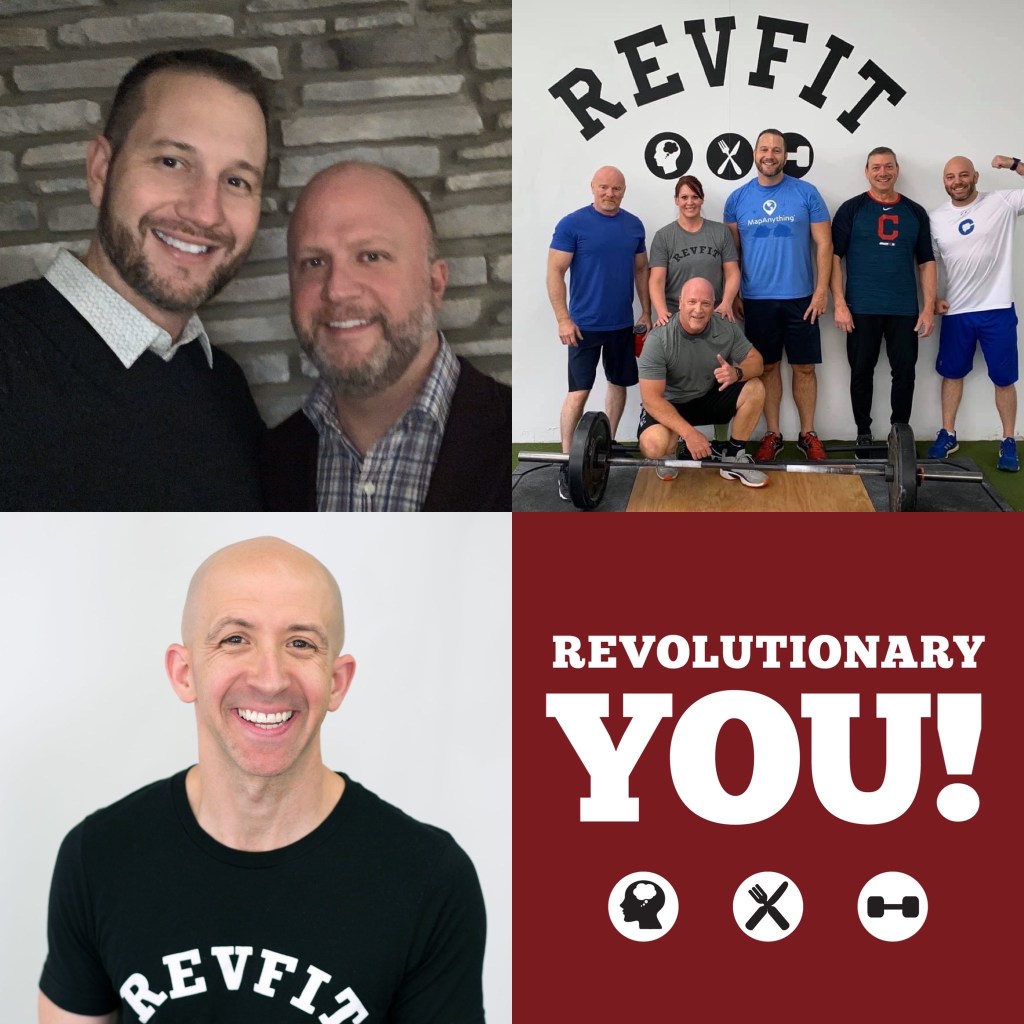
This week, I feature another client spotlight with one of my longest standing clients, Brandon Huth. I credit Brandon for being what I call the “gateway” client to the LGBTQ clientele we’ve been so proud to work with and train throughout the years. In this episode, we talk about what was happening in Brandon’s life when he started here, the role he has played in networking with others to bring them to train here at the studio and how our training relationship and friendship has evolved throughout the years he has been here. To buy your copy of my new book “A Revolution A Day”, check out Amazon.com for physical and Kindle versions. To learn more about your host, check out www.jasonleenaarts.com and www.revfittherapy.com You can also like our Facebook page at www.facebook.com/revolutionaryou Download, subscribe, share with your friends and please take a moment to leave us an iTunes review.
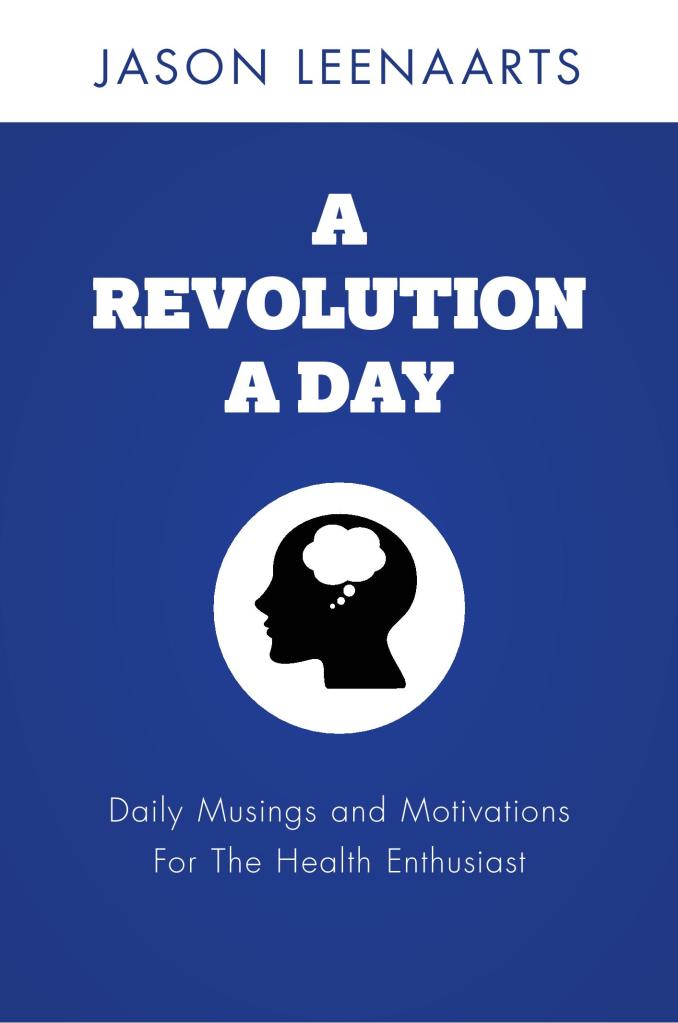
Last week, I submitted my final draft for my new book, A Revolution A Day. This project started at the beginning of 2019, although I admittedly dragged my feet on it for over half the year.
By time July came around, I knew I had wasted too much time and I developed a working plan to get the writing back on track. I detailed much of that in this article.
Amazon (KDP), being the monster that it is, had the book ready for print and purchase within 24 hours of my submission. I ordered a rather large batch to send out as tokens of gratitude to many of the guests who were kind enough to give me permission to use their words in the book.
For those who don’t know, I took quotes from nearly every episode of my podcast Revolutionary You and compiled them into a project of 366 days a la daily meditation. I wanted this to be focused on the individual looking to improve their health.
Beyond these quotes, I provided some of my own context and thoughts as well as action questions to get readers to think deeper about the choices they make for their health.
Because they are recurring themes on the show, you’ll find a lot of information about better sleep, smarter strength training, effective dieting strategies and mindset tips to help you rethink and reshape the way you approach those factors in your life.
I am immensely proud of the final product. Not because it’s mine but because it was a challenge to make this a collaborative effort. Most of my guests trusted my judgment with the quotes I utilized. Some asked to see their quotes ahead of time.
I pulled far more quotes than I needed initially and kept adding and removing quotes as I went along. Ultimately, I wanted to craft something that was fairly easy for anyone to read and understand but also to enhance the wisdom of my guests.
It is my hope that not only will the book inspire individuals on their journey but also lead them back to the podcast to listen to certain episodes in their entirety, learn more about my guests and purchase their work and services.
I say it in the introduction of the book and I will say it again here: I aimed to be the least important figure in the book. It was my desire to be nothing but a tour guide: someone to offer advice and then open the door for the reader to determine the path they wanted to follow.
As with so many things, this book was not my sole creation. Yes, I ventured back through hundreds of hours of the podcast, extracted quotes that made me pause, rewind, type, pause, rewind, etc. and add my own flavor to each page.
I also had the help of a dear friend and client, Jeanne, who took time out of her schedule to proofread the book. I fixed all that she asked me to fix (and there were a lot of things to fix) but I also went back and added and removed more after the fact. Wouldn’t you know, I still found a few typos but that’s not on Jeanne, that’s on me. While I don’t believe it will detract from the final product, it was one of those things where I kind of kicked myself and should have done another more careful read-through.
In addition to Jeanne, I had to ask the help of another friend and client, Amanda, who is far more tech-savvy than me. She helped with transitions of documents to pdf files, resizing of graphics, the addition of page numbers where needed and some other formatting hiccups.
My design guy, Nate Mannan, also returned to the helm to do all of my cover work for me. Nate did all of the design for my first book and has provided the art for both of my podcasts as well as a couple of shirt designs for our clients at RevFit. Nate is so incredibly talented. I love his simplicity and the fact that he rarely has to show me something twice. The first draft is nearly always perfect. The man has a gift.
I’ve had several of my guests (and friends) already start to blow up social media sharing some of their respective quotes where applicable and sending their audience to Amazon to purchase their copies.
As of this writing, I need to shout out: Chris Cooper, Sarah Moorman, Stuart Aitken (and the entire Lift The Bar community), Meghan Ramos, Dr. Jose Greenspon, Leslie Benedetto, Sumi Singh, Meghan Callaway, Susan Niebergall, Nikki Naab-Levy, Melody Schoenfeld, Ken Klika, Becki Siconolfi and Heather Robertson (and the Half Size Me community). Thank you for sharing the news with your audience and your friends. I do hope “we” inspire positive change in them.
A very special shout out goes to Joshua Shea who was on my show once before and will be again. He is a fellow author with quite a backstory and a very unorthodox guest for me to bring on the show. Joshua took to his own blog to write a review well beyond my imagination to promote not only my book but his new one as well. I can’t imagine stealing the thunder from this one but if you’d like to read Joshua’s take on the book, you can read that one HERE.
Writing a book of this magnitude (433 pages to be exact) was even more time consuming and stressful than I ever gave it credit for. I tried my damnedest to work on every single portion of it while I was at work but towards the end, I had to “bring my work home with me” and keep whittling away at home as well.
However, the final product I am tremendously pleased with. It took the work of hundreds of people (literally) to pull this thing together: guests, listeners and clients. This was truly a collaboration.
I was hellbent on releasing the book in December because, if you’re anything like me, you’d start it on January 1. I realize that is somewhat short-sighted though. Your transformation, or rather, your revolution can start on any day, in any month, of any year. You just have to start.
I believe A Revolution A Day can be a good companion on that journey.
(Yes, I am biased).
So, whether you purchase a copy for yourself, for a loved one or are just looking for a good stocking stuffer, I hope you’ll consider looking into it.
As always, thank you for reading, thank you for supporting and thank you for your feedback because, I, like you, am trying to get better every day as well.
The paperback version of the book can be purchased HERE
The kindle version of the book can be purchased HERE
I welcome Hannah Clausen of Macros Inc. this week for her debut on the show. In this episode we talk about finding your passion for fitness, navigating your comfort zone and thoughts on how to approach your goals during the holiday season. To learn more about Hannah’s work, check out www.macrosinc.net or join their Facebook group. To learn more about your host, check out www.jasonleenaarts.com and www.revfittherapy.com You can also like our Facebook page at www.facebook.com/revolutionaryou Download, subscribe, share with your friends and please take a moment to leave us an iTunes review.
Every time I tried meditating, believing it was a good thing for me to do, I failed at it.
In fact, I have been trying in some way, shape and form to meditate for over six years now.
In the fitness world, it’s hard to navigate all of the healthy things you can do for yourself without coming across someone who mentions the benefits of meditating.
When I first decided to give meditation a try, I had read a book called The Mindful Manifesto. It talked about the effects of stress and the benefits of meditation and mindfulness in one’s life.
So, I took some of the tips from the book and tried to add meditation into my own life.
I just couldn’t stick with it. My mind would race down one rabbit hole and into another. I wanted my thoughts to disappear and they wouldn’t.
I decided meditation was not for me.
Yet, I kept hearing about it and reading about it. More and more of my fitness professional friends and peers were talking about how beneficial it had been for them.
I thought, maybe I was just one of those special snowflakes who couldn’t find a way to make it work.
I tried apps with colorful visuals and apps with ambient music. Those didn’t work. The thought of transcendental meditation didn’t appeal to me either.
A few years ago, I found out about an app called Headspace. It was guided meditation, led by a gentleman named Andy Puddicombe. There was a 10-day free trial, so I gave it a go.
Something clicked.
Andy was telling me what he wanted me to do: how to breathe, what to think about, not to worry if my thoughts didn’t vanish, and reminding me that it was okay if it didn’t all work perfectly at first.
After the trial, I signed up for a year’s worth of Headspace. As the time went on, the goal was to increase the duration of time spent in meditation. This worked great…until it didn’t.
Meditation became a thing that, while I believed it was beneficial, I was not making a priority in my day. I kept finding other things to focus on and my time meditating kept working further down the list.
So, I quit.
From time to time, I’d hear meditation pop up again as a topic and I would tell myself “I should do that again…yes, yes, when I have time…”
2019 has been a banner year for me professionally. Business is booming, the podcast is great, the blog has been great and the book is nearly complete.
On a personal level, life has been challenging. I’ve had some injuries to work around that keep me from being and feeling my best at work, I’ve been working through some childhood trauma with my therapist and, while I wasn’t admitting it to myself, I’ve been really worked up about it (almost all of which has been internalized.)
The funny thing, is that your body has a strange way of letting you know that it’s not going to deal with stress anymore.
When I made that realization, I knew it was time to bring meditation back into the fold.
As I write this, I am still in my infancy going back to Headspace and starting from square one with meditation. I receive no compensation or kickback from that company. I have no referral link to use. It’s just what has worked for me and something different may work for you.
As I have a tendency of doing, I look at how meditation has worked in my life and can find the parallels between that diet and exercise.
So often, we want the things we do for our health to be automatic, instantly gratifying, one more quick fix after another.
I can assure you, meditation is not a quick fix.
If you’re like me, your life may have more stress in and around it than you realize. Regardless of how you want to add meditation in your life, here is some advice I can give you for greater results.
–Don’t try to eliminate your thoughts. Meditation helps you focus on your breath and on calming your mind. It doesn’t eliminate every negative feeling in your mind. Over time, you will notice a calmer take on what’s happening between your ears but it will take time (and patience.)
–Don’t expect your first (or second or third) attempt at meditation to work. As I referenced above, it took me several tries to find the right way to meditate for me. I knew that guided meditation, for now, was the best avenue for me to take. My mind likes to wander and I needed the voice to remind me when and what to focus on.
–You won’t automatically get better at meditation over time. Much like weight loss and strength training, progress with meditation is not linear. There have been days when I’ve had really great meditation sessions and days where I feel like I got nothing positive accomplished. You still have to put the time in and accept the less than perfect days.
–Meditation does not replace prayer. For those who believe in a certain higher power, it may seem sacrilegious to meditate instead of pray. I believe that you can have both. Pray, if you feel so inclined, so that you can communicate with that higher power as you desire. Meditate to calm your mind. They can (and should) complement each other.
–Experiment with different times of the day to meditate. Initially, I felt the best time of my day to meditate was late morning/early afternoon where I tend to have a lull in my schedule. Stress would normally be heightened by this point and I felt that meditation could serve to calm my thoughts down. While this did work at the beginning, lately I feel better when I meditate first thing in the morning.
If you have felt inclined to try meditating, based on things you’ve heard or testimonials from others, it’s worth trying and it’s worth navigating through the different forms of meditation. We all gravitate towards different stimuli. However, if life has been overwhelming for you, you may need meditation more than you realize.
Below is our little guy Sebastian doing his best impression of meditation. Thankfully, at two years of age, he doesn’t have a lot of worries in life to be concerned about.
Fellow coach, fitness writer, and podcast host (The Fitness Devil), Andrew Coates, joins me on the show for his first time. In this episode, we dive into the fact that we both have unorthodox routes into the fitness industry, the importance of networking, continuing education and learning how to focus on the productive things that matter with respect to business and life. You can learn more about Andrew at www.andrewcoatesfitness.com You can follow him on IG at www.instagram.com/andrewcoatesfitness and on FB at www.facebook.com/andrew.coates.58 For the fitness fans, I highly recommend his podcast The Fitness Devil with his co-host, Dean Guedo. To learn more about your host, check out www.jasonleenaarts.com and www.revfittherapy.com You can also like our Facebook page at www.facebook.com/revolutionaryou Download, subscribe, share with your friends and please take a moment to leave us an iTunes review.
There’s something very special about seeing someone get stronger.
In the framework of what we do at RevFit, it’s great to see someone hit a new personal record (especially if they’ve plateaued for any reason).
However, what about the strength that gets us through life and not just what happens in a gym?
When Pat (age 71) first started training with me, she had recently been diagnosed with emphysema. This diagnosis came despite the fact that she has never been a smoker.
Pat has cycled through several stages of weight loss in her life and so that was certainly something that we established as a priority for her. We (she and I) believed that the weight loss would benefit her breathing capacity.
Throughout the time she’s been with me, she has seen some weight loss. Although, she has also dealt with some personal tragedies and some other health issues that have made weight loss temporarily take a back seat.
Due to some of those health issues, we have not been able to train her lower body as much as we’d like. Instead, we’ve focused primarily on upper body work, some core work and a very limited amount of lower body exercises.
At one point she said to me “You know, thank God I’ve been doing all of this upper body work with you. Just to be able to get in and out of the bathtub is a big thing for me!”
Pat also helps with her elderly parents, both in assisted living, and has had to rely on her strength to physically help move them when need be.
For most of my clients, I have them on 4-week training cycles. Where possible, and for those who are physically able, we keep the big lifts (squat, deadlift, bench press) in the cycles and change out all of the supplemental exercises every four weeks.
Due to Pat’s current impairments, the only one of those big lifts that has remained a staple is her bench press.
Which means that she sees a fair amount of variety in her training and we are constantly looking at where we can increase her relative strength either with more reps, more weight or more sets.
What we’ve seen change over the years that Pat has been here is a sense of confidence in what her body is capable of. Sure, she can lament what is not feeling ideal, but she always manages to come in and focus on what she can do versus what she cannot.
And this is really the inspiration for why I wanted to write this article today.
Pat is working within her limitations of what she is physically able to do. Some days, she comes in and she tells us “I’m just not feeling great today” but she gives us her best effort.
Pat, to me, personifies “strong.”
Not because she can out lift the other women in the gym, but because she’s not afraid to push her body, achieve more and feel accomplished.
It doesn’t have to be ideal, it just has to occur.
Strength means one thing in our twenties. Many of us have bodies that are resilient, recover quickly and can often make great strides in strength increases.
That strength changes and morphs as the decades pass and the importance of what we lift and how we lift it changes as well.
Strength, for me, never meant more until my father was dying from cancer. I was never more grateful that I could deadlift a few hundred pounds from the floor than when I had to hold and lift and shift my father’s body whenever he couldn’t move himself. That was a gift that training gave me. That gift was invaluable.
For clients like Pat (and we are fortunate to train several clients in their 70’s and beyond), strength means something else altogether. It’s not about vanity, it’s about living.
And so this article is in celebration of not just Pat, but everyone who is willing to put forth the effort and the work to get stronger.
This article is being released days before Thanksgiving so I would be remiss if I didn’t share my sincere gratitude to every client who gives us the privilege of helping them find their own strength and taking it as far as their bodies will allow.
Below is a recent picture of our Pat, right after she hit an all-time high on bench press of 85 pounds.
We love you “Mama Pat.” Thank you for your strength.
This week, I’m honored to welcome life coach, Jessi Kneeland to the show. I’ve been following her work for several years and have always found her take on body image to be both empowering and refreshing. In this episode, we talk about the effects body image can have on our self perception, how trauma can affect those images and the consideration of body neutrality. Jessi also takes on a couple of listener questions as well. To learn more about Jessi’s work, please visit www.jessikneeland.com and follow her on IG at www.instagram.com/jessikneeland and on FB at www.facebook.com/jessikneeland To learn more about your host, check out www.jasonleenaarts.com and www.revfittherapy.com You can also like our Facebook page at www.facebook.com/revolutionaryou Download, subscribe, share with your friends and please take a moment to leave us an iTunes review.
When I sit down with potential clients, I come to a part in the consultation where I ask the individual(s) what they eat/drink from the time they wake up until the time they go to bed.
The responses, of course, vary.
And I could write an entire book on all of the nuance of what I hear in these consultations.
However, I do hear about one food choice arguably more than many others.
A lot of these individuals eat salad.
Let me clarify this further and say, a lot of these individuals who come to me for weight loss, frustrated by their lack of results tell me they eat salad.
Clearly someone who eats a meal that is predicated on a boatload of vegetables can’t possibly have a challenge losing weight, right?
The problem lies in how that salad is crafted.
When you take things like: lettuce, spinach, arugula, kale, tomatoes, mushrooms, peppers, carrots, beets, etc., you have a fantastic and colorful blend of vegetables that are chock full of vitamins and minerals and very low in calories. This is a great thing. You’re NEVER going to hear me say that those are bad options.
Then, folks start to get creative.
People hear that they need to eat more protein. So they add things like grilled chicken or grilled salmon, or some slices of steak, diced ham, etc.
And I’m thinking: “Hey, we’re still doing okay. This is still a good, balanced meal.”
And then something goes terribly awry.
Because the creativity amps up and now you see: feta cheese, blue cheese, mozzarella cheese, goat cheese, nuts of all varieties, eggs, avocado slices, and let’s not forget….DRESSING!!
Folks, this is where a salad becomes your nemesis.
One ounce of most cheese (not all) is approximately 100 calories. I’d like you to try measuring that ounce out in the comfort of your own home. Try not to gasp. It’s a painfully small portion.
One ounce of most nuts (not all) is approximately 100 calories. You can measure that out too in the comfort of your own home. Try not to get weak in the knees when you see how little that is.
1/4 of one avocado is nearly 100 calories. Think about that for one second. An entire avocado is at least 300 calories.
And then, the one thing that can completely derail a perfectly appropriate salad and take it straight into CrazyTown (population 1.4 million and climbing) is the salad dressing.
“But Jason!” you exclaim “I use oil and vinegar and olive oil is a healthy fat!”
Yes, my darling readers, olive oil is a “healthy” fat (so are nuts, so is avocado.)
And one tablespoon (go ahead and measure) is over 100 calories.
And when we (myself included) are preparing salad for ourselves, we rarely ever measure. We eyeball. And one thing I try very hard to repeat to my clients is: “If you’re not measuring, you’re guessing. And if you’re guessing, you’re probably wrong.”
Measuring is not fool proof but it is a damn sight better than guessing. Because, frankly, most of us suck at guessing. And I’m talking REALLY suck at it. Dyson should hire us for how much we suck at it.
Um, that got weird fast…
Most salad dressings (full fat) are nearly 100 calories per tablespoon. Yeah, you should try measuring that too. Take that measured level tablespoon and drizzle that over your salad. Does that make you cry? Hell, it makes me cry and it’s not even my salad.
And here’s where it gets even worse.
Many people order their salads from restaurants. And the restaurants get to choose what and how much of something they put on a salad.
Yes, you can absolutely request that your dressing come on the side. You SHOULD do this before they drench your salad in dressing.
And typically, what you are served is a little container of dressing that on the low end probably has 200 calories of dressing in it and on the high end, I’ve seen offenders of over 500 calories. JUST IN THE ONE CONTAINER.
If you’d really like to spin your head back at a restaurant, especially those restaurants where they are kind enough to print the calories, try comparing your salad of choice to a hamburger. Sometimes there is no difference, meaning you’d be just as well off to eat the greasy hamburger as you would the salad (although you do get far more veggies into your tummy with a salad choice.)
Restaurants have become even more crafty as well. So, when they offer their calories, they may or may not include the dressing as part of the total in a salad option. And, as far as that burger goes, they may only print the calories for the burger itself, not the total calories if you opt to take the fries with it (as opposed to say, side of broccoli.) And let’s be honest, how often does anyone order the burger and say: “You know those fries sound delicious but I’ll take the steamed broccoli instead!” Not often, not even when they order a diet Coke to save on calories…
So, before you take the information from this week’s article and tell your friends: That crazy bald man/trainer/friend of mine said salads were bad for you, I’m only ordering burgers!! That is definitely not the purpose of this post.
What I am trying to tell you is that the way you concoct your salad may be hurting your weight loss goals. Remember, we’re looking at total caloric intake here.
So, if you need a better strategy for a salad that will work better for your weight loss goals, load up with veggies, add a protein source (meats and/or seafood as opposed to nuts and eggs) and as little dressing as humanly possible.
Most importantly, the devil is in the details with your food choices. If you’re struggling to lose weight, there’s normally something happening with calories you’re either unaware of or not giving appropriate credit to (like salad dressing.) Even things that appear innocuous and otherwise “healthy”, like salads, can be massive calorie bombs.
So, armed with all of that knowledge, I’ll ask again: You still want that salad?
Mike Howard returns for the triumphant fourth time to the show to promote his soon-to-be-released new book, “Lean Minded.” To venture back into our previous episodes together, check out Episodes #64, #102, and #159 (also with James Krieger.) In this week’s show, Mike talks about 4 topics that he presents in his book and how they can serve you best on your journey of self-improvement. I can’t recommend his work enough. To learn more about Mike’s work and to be in the loop to get your copy as soon as it comes out, visit www.leanminded.com You can also follow him on Facebook at www.facebook.com/leanminded and on Instagram at www.instagram.com/leanminded To learn more about your host, check out www.jasonleenaarts.com and www.revfittherapy.com You can also like our Facebook page at www.facebook.com/revolutionaryou Download, subscribe, share with your friends and please take a moment to leave us an iTunes review.
As reliable as the scale can be for telling you exactly what you weigh on a given day, it’s never going to tell the whole truth about what’s happening in your body.
Let’s assume you’ve reached the point where the scale is no longer your friend and there’s nothing more you’d like to do than smash it to bits and pieces. Here’s a list (in no particular order) of some other things you may want to look into that could help get that scale number back in your good graces.
How Are You Sleeping?
Sleep is one of the most overlooked factors in successful weight loss. It affects your ability to recover from your previous day’s activities, regulates the function of your hormones and can affect your hunger the following day. Start keeping track of how many restful hours of sleep you average per night. Many wrist trackers can offer this insight but be mindful of the fact that spending too much brain power on better sleep can give you some anxiety (resulting in poor sleep.) Stick with the low-hanging fruit: limit caffeine after noon, reduce alcohol intake, turn off electronics at least 30 minutes before bedtime, keep the room relatively cool, and aim for as dark of an environment as possible.
Feeling Salty?
Start watching your sodium intake. Many of my clients don’t add extra salt to their dishes but if you’re someone who frequents restaurants, you can easily surpass your daily recommended sodium intake in one meal alone. While you don’t necessarily have to go “no salt” in your diet (unless directed by a physician), your body may retain sodium more so than others. When you compound sodium retention with a lack of water intake, the scale probably won’t be happy with you. And while we’re on the subject of water…
Ain’t Ya Thirsty?
Water, water, and water. Yes, you probably should grab another swig while you’re reading this (go ahead, I’ll wait.) While there is some dispute about how much you should have on a given day, I’ll offer a guideline of 80-100 oz per day. I would even suggest you do this in addition to any other fluids you might be taking in. So, even though coffee, tea and your favorite sparkling water all count (sort of), I want you to aim for 80-100 oz of the good ol’, plain jane, boring as hell water. I’m not going to go down a rabbit hole of all the alleged wonders of water intake but I will tell you that it can help you with the sodium issue referenced above and help with the removal of waste from your digestive system. I have clients who can swing as wildly as 10-12 pounds on a given week when they’ve had a weekend full of events and little to no water. Once they spend the following week getting food and water intake back on track, the weight plummets down again. Think about that for a moment. Would you be happy with upwards of a 10 pound swing in scale weight over a week? (Results not typical.)
Don’t Forget The Poo-Pourri
While I’m on the thought of digestive systems, how’s your fiber intake? With ladies needing 20-25g per day and fellas needing 35-40g per day, where is your current intake? Start looking at your daily sources of fiber to continue removing waste from your system. I would suggest sticking with whole food sources before you attempt to get what you need from supplements or Quest Bars. If a doctor has recommended a fiber supplement for you, follow their advice but you may start seeing better results when you’re more consistent with bowel movements.
To Carb Or Not To Carb?
If you’ve been lacking in consistency with carbohydrate intake, remember some rules of thumb. If you’re a less active individual on average, your body will likely do better with lower carbs. If you’re more active, you can have more. When I mention this, people like to fall to extremes. Try not to do this. Lower carb could simply mean a shift down from 150g of carbs per day to 100g. Higher carb could be 150g to 200g. This is different for different people. You won’t know where you are unless you’re tracking but keep in mind that carbs hold water so a shift in either direction can affect what the scale might read. This is why folks who shift from their typical diet to a low carb or keto diet see a plummet in weight (initially.) Once the body regulates to overall caloric intake, the honeymoon is over.
Tame The Weekend Warrior
I see so many people eat within their respective goals Monday through Thursday. And then the proverbial gates of Hell open up over the weekend and the willpower goes right out the window. Try to minimize your caloric luxuries over the weekend by cutting back (not necessarily eliminating) the social events. All too often (especially with women), I see clients who not only lose the ground they had from the previous week’s efforts but can have a weekend so off the grid, that it takes them at least a week to recover and get back to a previous low. You’re aiming for consistency, not perfection but cooling the madness of the weekend warrior can help.
Use The Same Scale In The Same Place Under The Same Circumstances
Not every scale is calibrated the same way. Here at my studio, I have an exact place that I set the scale. Shifting it slightly to other areas can make the difference in ounces or pounds depending on how even/uneven the floor is. Make sure your scale is in the same place every day and keep some consistency with the time and environment in which you weigh. For instance. weigh yourself when you wake in the morning, after urinating and get in your birthday suit (if you aren’t already.) Use that as your given baseline for weight. Yes, you could theoretically be lighter at another point in the day but you could also be heavier. You’re looking for an average over time.
Accept The Fluctuations
One thing I like about tracking your weight via an app is that many of them will offer a graph so you can see the spikes and the dips. This visual can be very helpful so it’s not just about a number. I used to offer the wiggle room of a four pound swing on any given day. In other words, depending on many of the variables mentioned above, your weight could swing as wildly as four pounds at any point in the day and that’s normal. Over time, I’ve found some people can swing even more than that. If we only use the four pound swing, that means you could hit a new low of say 162 in the morning and be at 166 in the afternoon and it be completely normal. This does NOT mean that you magically consumed nearly 14,000 calories of actual food. Do not let the scale trick you!
Grab Your Measuring Tape
There are three tape measures we use to check progress here. We measure in centimeters and those three areas are: one inch above the bellybutton (around the body), at the bellybutton (around the body) and at the mid-glute (around the body.) If the scale is being an asshole, try tracking these measurements for a while and see if your numbers are changing.
How’s That Food Tracking Going?
When I mention food tracking, some people bristle up. It’s boring, it’s too time-consuming, etc. But here’s the thing: when you do it right, it works really well and, like so many things, it’s a skill. Work on improving it. It’s not fool-proof but it can be damn helpful. It’s also not something you have to do indefinitely. But for a few days, track/measure every morsel that goes in your mouth up to and including the cream in your coffee, salad dressing, nut butters, those six pistachios you just ate, the nibble of grilled cheese off your kid’s plate, and even that eyeballed glass of wine. Track every single bit of it. If that doesn’t open your eyes, please go see your optometrist (I’m only sort of kidding.)
Be Patient
Sometimes, you really are doing the right things with your diet and your training. You’re not dieting aggressively and you’re not beating your body to shreds in the gym or on the treadmill. What you need is to just be patient that you’re body isn’t fighting to hold onto the weight. The body will do all it can to achieve homeostasis and cling to the weight as a survival mechanism. This doesn’t mean you’re doing anything wrong. Just go back through this checklist and make sure that some of these factors are still in place.
I would be remiss if I didn’t tell you, that if you’ve allowed some of this list to get off track, you probably don’t want to tackle all of these things at once. It’s too much change to take on at one time. Focus on one area and see if that gets the scale moving in the right direction again. If not, try the next thing that could be in the way.
Lastly, in the grand scope of your life right now, maybe weight loss isn’t your best path to follow. In that case, take a week or two to eat at maintenance, gain some clarity on where things may be too stressful right now and schedule a time to start back again.
Below is a shot of some of our resident wild things. This was taken after one of our Saturday circuit sessions. I’d like to introduce you (left to right) to: Bill, Jean, Kelvin (in front of Jean), Brandon, Pete and Shon. We love them. And, because they’re real people just like you, the scale is sometimes an asshole to them too…



 Jason Leenaarts