Tony Gentilcore returns after a great first episode with his wife Dr. Lisa Lewis back on Episode #157. As of the recording of this episode, he is not only recovering from an injury but still dealing with business closure in the state of Massachusetts. We talk about why studios like his CORE and my RevFit should be considered different entities from box gyms and group exercise formats in light of the pandemic. We also discuss how all of his business: speaking engagements, travel, and online programs have been affected and how he plans to move forward. Download, subscribe, share with your friends and please take a moment to leave us an iTunes review.
For as long as I can remember, I’ve collected things. When I was a child, it started with trading cards, then comics, then cassettes, CDs, etc.
I’ve since gotten rid of all of those things over the years. I’d move from state to state when my family would get transferred, find another thing to be fascinated with and start collecting that too.
When I started RevFit, my next collection became my books. I’m a voracious reader and while I can’t say that I have many collector’s items on my bookshelf, it’s nice to walk into my office where I keep all of them and see what I’ve read, what I’ve loved and what I have yet still to read.
Several years ago, my wife bought me a vintage turntable and that turned me into a record collector (shocker, I know!) It was with records that I chose to be more particular with the way I purchased. I’m more into limited edition versions, special colored variants, etc.
Somewhat in jest, my newest fascination I wholeheartedly blame one of my clients, Bill K., for. That would be my bourbon collection.
Last year, Bill and I were talking and I had mentioned that I liked bourbon but didn’t know much about it. Historically, I’ve never really been a heavy drinker. I don’t have the physical tolerance for it, nor is it something I’m looking to develop.
As I’ve gotten older, beer and wine don’t sit well with me as they did once before, so bourbon became the drink I could handle without feeling bloated or just wanting to fall straight to sleep as wine has a tendency to make me do.
Much like anything, you can fall down a significant (and expensive) rabbit hole with bourbon. It was this rabbit hole that inspired me to write this week’s article.
What does your health have to do with an ever growing bourbon collection in my dining room?
Well, follow me down this path for a bit.
As I mentioned, Bill was the one who I credit with really lighting this fire under me. When he found out that I had an interest in bourbon, he asked me if I had ever tried one called Blanton’s. I had not.
If you’re a bourbon drinker, you are probably already smirking at this.
Bill was kind enough to gift me my first bottle of Blanton’s. It’s a tasty one and it normally sells for around $60. There’s a caveat to that, though. Supply and demand is such that Blanton’s is not particularly easy to find in most parts of the U.S. and I’ve seen secondary market prices of upwards of $200 just to buy one bottle (thanks, but no thanks!)
Of course, once the bug bit me, I started trying to learn more about bourbon:
-What were the best kinds?
-How easily can they be found in Ohio?
-Are the more expensive ones actually better in taste?
For Christmas last year, Bill (that terribly kind soul that he is) gave me a limited edition book that helped me learn a little bit more about the making and history of bourbon along with a convenient list of bourbons that “should” be on everyone’s shelf.
That’s pretty much where I took off with it. As I was reading that book, I happened to be driving down to Tennessee (conveniently passing through Kentucky, the indisputable birthplace of bourbon) and I started looking at shops down there to see what I could find.
I learned a fair amount on that trip. I learned that each state runs their liquor sales in totally different ways. In Tennessee, for instance, liquor stores can charge whatever they want independent of one another. By comparison, in Ohio, the stores are overseen by the state board and (essentially) every store in the state has the same prices (which can be good or bad depending on the item).
Needless to say, I came home from that trip with the first inkling that collecting these bottles would be my new thing.
Curiously, I don’t have the olfactory senses that allow me to accurately pick out all of the notes in bourbon. I can’t really tell you if there’s caramel, vanilla, pepper, or butterscotch. All I know is: I like how that tastes and it’s either strong (high proof) or not. More on this later…
I’ve also discovered that while I love learning more about different bourbons and distilleries, I don’t have a huge interest in buying extremely expensive (a relative term) or very rare bottles (Pappy Van Winkle, anyone?)
Much like collecting records or books, I like seeing the collection grow but I want to be able to enjoy what I have and fulfill that obsessive nature of mine to watch shelves fill up over time.
I would say though, that my bourbon collection maybe more closely resembles the way I collect books. I don’t need the most expensive or the rarest bottle, I want something that I can simply appreciate and perhaps recommend to others (which is of course where my fascination has led me to of late).
Little by little, I’m learning more about how bourbon might pair with certain foods. I like a good rye but Heaven forbid, don’t try pairing a rye with a spicy dish. It’s not a good match! A high proof pick is the way to go if you’re going for spicier foods.
Often times, I work with clients who find themselves interested in following certain diets or diet trends. There’s nothing inherently wrong with that. People need to find the way that resonates with them, their values and their lifestyles.
However, more often than not, I find clients who can regurgitate mountains of information about their diet “du jour” and for some strange reason, they can’t successfully stick with or succeed with those diets.
This where I want to start drawing something of a parallel between my approach to drinking and enjoying bourbon and your personal quest for better health.
It’s a perspective I’d like to offer you.
–Learn just enough.I’m learning a lot about bourbon because I find it genuinely interesting. However, not every facet of it isinteresting. I’m not concerned with whether or not I can sense every note in a bottle. I just want to find things I enjoy and might complement a given meal. When you decide you’re ready to take care of your health (lose fat mass, gain lean muscle, etc.) you may need to learn things like what a calorie deficit is (eating consistently less over time than what your body burns in a day) and what progressive overload is (how to get stronger over time while minimizing injury). If you go too far down the Google hole, you gain a whole lot of information but you don’t develop consistent action/execution. You end up with a head full of knowledge and no results to back it up.
-Everything in moderation.I don’t drink to get drunk and historically, I’m a one-and-done drinker. While I can’t admit to moderating the amount of bourbon I own (or records or books), I do moderate my intake. It’s why you frequently hear bourbon drinkers talk about good “sippers”. You want something that you can savor and take your time with. Anyone who has ever embarked on a diet or exercise plan knows what it’s like when they take things too far. Either the plan becomes unsustainable or an injury occurs. Then you lose ground and progress because you didn’t operate within the framework of what your body/mind can currently handle. While the middle ground might not be sexy or fancy, it is where the most reasonable and realistic results can happen over time.
–Find your society.I was recently listening to a podcast for bourbon fans and I heard a sentiment I’ll share (paraphrased) with you. If more of us could spend time sharing (sipping) a drink with one another and just talking/listening, we’d have a lot less problems in this world. Of course, if for any reason you don’t partake in alcohol, bring a glass of water or coffee to the table. If you want to have a healthier life, find people around you who “fill your cup” (pun intended), not people who tear you down and leave you worse off after each interaction. Find friends/family members who support your goals and make new friends along the way (of any color, creed, religious/sexual/political preference) who can help you broaden your understanding of others and maybe make you a better version of you. Some of the best conversations and learning experiences I’ve had in my life have come from people of different cultures and backgrounds than myself.
–Have fun.Unlike buying books or records, which can easily solve the thrill of the hunt with a quick search online and a “Buy Now” option, not all bourbon purchases are worth the online hunt. Those particular merchants may or may not have the bourbon you’re looking for at a reasonable price. Then, of course, you get gouged with shipping rates. This is where I’ve seen some merchants sell particular bottles at a decent price but then do a savage markup on others (like the aforementioned Blanton’s). I’ve learned to make friends with Mom & Pop local liquor stores and become a regular patron. When special or limited items come in stock, it keeps me top of mind if the owner wants to hold something behind the counter for me that others may not have access to. This makes bourbon collecting fun for me. Arguably, the best things you do for your health are the things you consider fun. Maybe they get you together with friends who make you laugh or you can forget about your stressful job for a while. Whether you’re teaching yourself how to cook or you’re learning how to get better at a particular lift, have fun learning the nuances of how self-improvement can put a smile on your face and not be a chronic drag because you’re chasing an arbitrary goal. Not every aspect of improving your life has to be one that makes you drag your feet.
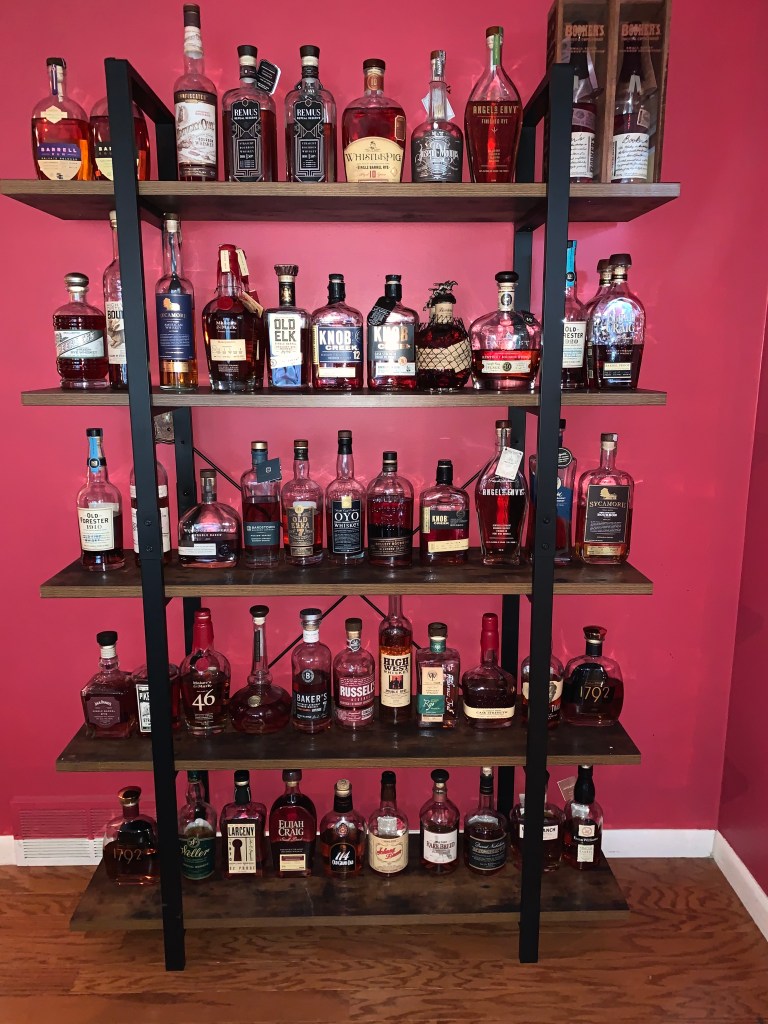
Below is a picture of some of my collection. It’s almost displayed accurately as Top Shelf (more expensive) to Bottom Shelf (less so). With bourbon, however, a higher price doesn’t equate to better taste. Taste is subjective. Some of my very favorite ones are in the mid-range and some of the bottom shelf products are fantastic mixers if you’re into cocktails. I personally favor bourbon neat (no ice).
Your healthis far more than what you eat and how you train. It’s who you surround yourself with, how you relax and unwind, and how you recharge your batteries. Maybe you’ll never be a bourbon drinker and maybe this post will inspire you to venture out and try some. Either outcome is fine by me.
The beauty is in finding the path that works for you.
Patrick Umphrey of Eat, Train, Progress fame returns for his 4th appearance and 4th year in a row of our Father’s Day celebration (See episodes #70, #125, #195). As many know, he and I are both fathers to two children, one with special needs and one who is neuro-typical (Patrick has a son and daughter and I have two sons). In this episode we talk about what’s been happening in the lives of our children, our coaching practices and how we’ve been adapting to the pandemic and the social events happening today. Download, subscribe, share with your friends and please take a moment to leave us an iTunes review.
I heard something not too long ago within my industry and it’s escaping me where the insight came from.
The belief was that, as a trainer, if you start coaching a particular client for weight loss and later their partner decides to start training with you as well, that the latter is the one who is more resistant to change.
When I read that, I had to think long and hard about that statement. There were no statistics. It was an observation.
As I tend to frequently do, I look at my sample size of clients. From the current ones to the former ones, do I see the same things that other coaches in other cities, states and countries see?
Let’s come back to that in a bit.
I do not sugarcoat the fact that dieting, when done responsibly and sustainably, as opposed to aggressively and somewhat carelessly is difficult.
That’s me being kind about it.
Yes, it’s about taking in fewer calories than you expend done consistently over time but it’s just not that easy to fit weight loss goals into the framework of our stressful, emotional and unpredictable lives.
If you were a single person, living alone, no kids, and working full-time, you would have difficulty adhering to a diet plan. However, one could argue this might be the ideal circumstance to lose weight in. There is less resistance in your life.
When you add in the dynamics of a spouse/significant other and children of any number, the resistance in your life increases.
Couple this with the fact that many people use food as a way to cope with stress, to show love and to be social. It is a necessary and vital part of our lives.
Yet, something strange tends to happen when one partner decides they want to lose weight. This is something I started to write about severalmonthsago. They upset the status quo.
Now, unless you’ve been living under a rock and you’ve never tried this whole dieting thing before, you’ll know that something has to give if you want to lose weight.
So, you start that conversation with your partner and you say something along the lines of: “You know, I really don’t feel so good about my body lately. I’ve decided I need to try and lose some weight.”
Maybe you have a weight loss goal in mind or maybe it’s to get yourself down to a certain size of pants. You may decide whether or not to share those goals with your loved one.
In our household, it went something like this:
After our son, Sebastian, was born, my wife lost a fair amount of weight initially and then she plateaued.
Eager to get back to her pre-baby weight, she asked for me to help her continue her weight loss.
Knowing her habits the way I do, it became less a conversation of “Here’s how many calories you need to eat” and more about reminding her what eating behaviors worked best for her.
In Marissa’s case, she can normally start her day with just a cup of coffee and then go several hours with little to nothing to eat. She can usually eat a small snack and then tide herself over until dinner time.
Shortly after Sebastian was born, I started cooking more at home and I knew approximately what portion sizes would work best for her. So, in her specific case, she could generally get by with one small meal/snack and then a larger dinner. That was it.
Before anyone gets carried away trying to replicate this, I will caution that Marissa’s own spin on intermittent fasting works well for her because it’s the way she’s eaten for most of her life (before she ever knew the term intermittent fasting).
I also don’t recommend this tactic for most people because I can’t replicate her results over and over again.
From what I’ve seen, most spouses will show a sign of support. That might come off as something like: “Well, I think you look beautiful/handsome as you are but if you’re going to do it, I support you. Just let me know how I can help.”
This might seem like the ideal scenario. Partner A wants to lose weight and Partner B shows support for that goal.
By comparison, a more skeptical or pessimistic spouse might ask: “How much is that going to cost?”,”Do you even have time to work out with your busy schedule?”, or “We’ve been down this road before…”
This is, obviously, where resistance can creep in right from the beginning.
I should also mention that the first example of the more supportive partner can still turn against you.
The same supportive spouse can come home after both of you have had a busy week and say “You know what, let’s not cook tonight. We’ll order takeout instead.”
And if you’re a woman, you typically don’t have a lot of calories to play around with and still be successful at weight loss. So, you can take Monday through Friday of “good eating” and literally lose all the ground you had worked towards with one average meal from a restaurant. Then you’ll hop on the scale a couple of days later thinking you had 5-6 “good days” and wonder why you didn’t lose weight…
Oh, and regarding that theory of the latter partner being more resistant to change? Yes, I’ve found the same thing to be true (usually) with my clients as well. It’s not necessarily out of malice. Sometimes, the first of the couple to come through my doors has decided they’re fed up with their circumstances and they need my help. Often, the partner is either not needing to lose weight or is not ready to tackle the challenges that come along with doing so.
Here are some tips to help make sure your significant other is a help and not a hindrance when you’re trying to lose weight:
Have The Uncomfortable Conversation. Know the verbiage that helps you get through to your loved ones. The same words that you might use to discuss finances will be similar to successful weight loss. It’s a team effort and it’s a sensitive subject. Talk about your triggers (foods and situations you don’t feel in control of) and talk about the words/phrases that shut you down or make you rebel.
Control The Food Environment. Can you eat potato chips, pretzels or crackers with reckless abandon? Think about the foods that you feel you cannot moderate successfully. Ask your significant other if they can limit the frequency of those items being in the house or not have them visible to you if they are purchased. Imagine if one of you were trying to abstain from alcohol for any particular reason but the other person always has a drink in front of you. What is your reaction to this? Can you control your diet behaviors under these circumstances?
Enlist The Help Of A Therapist. Dieting and weight loss don’t fix every problem we have. Sometimes, you need a professional to dig deeper into the emotional core of why you eat the way you do or why you use food to heal those problems. This may also require your significant other to be present so they can hear another perspective on your food relationship and how they can help at home.
Find Other Nighttime Strategies. If the routine is dinner, then television, then snacking, then bed, how can you change that? What can you and your family do that doesn’t involve food beyond dinner time? Many people are motivated to eat when they watch television so ask your significant other what other activities you can be engaged in that don’t stimulate your appetite. (HINT: This may include going to bed earlier than you’re used to).
Remember That This Is Temporary. Much like the lockdowns and quarantine most of us experienced over the last two months, fat loss, done right, is a temporary solution. You follow the plan, hit the best weight for your body and lifestyle and live at maintenance. The more your significant other stands in the way, the longer that “temporary” stands to last which only ends up frustrating and discouraging all parties involved. Make a pact to support the cause and control the necessary variables.
As of this writing, Marissa is down to a weight she was before she was pregnant with Sebastian. It didn’t come quickly and there was no race to the finish. It was steady effort from her knowing what style of eating she naturally could work with and me knowing how to help with meals when we are both home together.
It took candid conversations and it took patience.
Because the basics still work, if you work them. You just need the right support to help you get there.
Georgie Fear returns after some time away and three extremely popular episodes we’ve done together (#51, 81 and 121) and K. Aleisha Fetters returns with her (see episode #249) as they have recently released an awesome book they co-authored: “Give Yourself More”. In this episode, we talk about why women have continued to be encouraged to be “less” as opposed to more and how that affects their diets, their self-image and the marketing messages they can be influenced by. The book itself is EXCELLENT and a highly recommended read. Download, subscribe, share with your friends and please take a moment to leave us an iTunes review.
To purchase your copy of the book and to find out more about Georgie and Aleisha:
If you’re looking for an article to dispute the importance of the almighty calorie, this isn’t it. Whether you recognize it or not, acknowledge it or not, the calorie still matters for fat loss.
However, the calorie isn’t the best measure for everyone to use if they want to succeed at fat loss.
Over the last several years, I’ve acclimated to a piece of software that allows me to put several pieces of data in to cough up a pretty good indicator of where a client’s calorie goals should be. I can get us down to the grams of protein, carbohydrate and fat content (ranges, mind you) to damn near guarantee success. I’d be lying to you if I told you that every successful client of mine followed that data to a “T”. They don’t. Thankfully, they don’t have to.
It’s estimated data points and they’re simply there for a guide, not as the end all be all for success to occur.
Since the pandemic hit, I’ve still been taking on new clients but due to social distancing, I can’t do all of the up-close measurements that I’m accustomed to.
That means, that we have to find other ways to tackle the intake of food (or fluids that contain calories) to arrive at the same goal of fat loss.
While I do find calorie tracking immensely eye-opening when done correctly, it’s not always necessary and can have a sabotaging effect for certain people.
What other options are there?
Right now, I’m asking my new clients just to tell me what they eat.
I document what they consume in foods and drinks from the time they wake up until the time they go to bed. Some people give me graphic details of all they eat: down to the flavor of cream in their coffee to the condiments they put on their sandwiches and the dressing they use on salad (it ALL counts).
Others tend to be more vague when they describe what they eat. It’s not to be deceitful, it’s because they’re either unaware or they’ve forgotten. Hell, I can’t even tell you what I ate two days ago with great accuracy unless I was tracking it.
For those who have the details down, it’s about finding the places where you can make a reduction.
Assume for a moment, that you eat 3 meals a day of varying sizes. You also eat at least one snack and have at least one alcoholic drink. Where will you cut back? One person might elect to remove the snack and the beer and another person might say, I’m keeping my snack and beer but I’m removing breakfast. Cool! That’s where we start.
After 1-2 weeks of this simple change, you reassess by checking the scale, checking how your clothes fit or even if there’s been a change in the belt loop. It all matters as a reference point but everyone has a different tool they’re comfortable using. Use the one that makes you feel best and appears to be accurate.
To highlight my thoughts with a recent client consultation, Don M. and I were talking about how to get his diet in order. His wife, Amy, has been a client of mine for awhile and has been encouraging him to start with me when the time felt right.
Don and Amy are both dealing with different eating challenges. Both are with me for weight loss. When Don told me about his diet, it really didn’t appear to be concerning. So, I asked the question somewhat differently: Which meal tends to go awry for you?
Without hesitation, he said: Dinner. Absolutely.
I suggested he eat the same size dinner as his wife. This isn’t a “forever” change. It’s something that they can do together, hold each other accountable for and help each other succeed together with. I also wouldn’t suggest this to everyone. I just want Don to kickstart with some momentum and if dinner is his problem area, I want to focus there first.
We’re often at the mercy (subconsciously) of following the social cues of others. If I reach for seconds when I eat dinner with my wife, she’s more likely to eat more as well. Think about how you react to social cues when you go to a restaurant and order an unplanned appetizer because it was suggested to you or how you go for seconds (or thirds) at Thanksgiving because you see others do so.
What’s good about this is that awareness of these vulnerable areas can make people more proactive moving forward, without counting a single calorie.
At a certain point, Don may plateau with his weight loss and we’ll have to investigate further to see if anything else is slowing his progress down.
For now, tactics that can work for him can work for you too. You don’t have to keep a food journal every day (but you can if you’d like), you don’t have to count calories or macros (but you can if you’d like) and you don’t have to measure every morsel you eat (but…you can if you’d like).
Find the areas that look “slippery” to you and focus your efforts there first.
Stay tuned over the next several weeks to get an update on how Don and Amy are succeeding together.
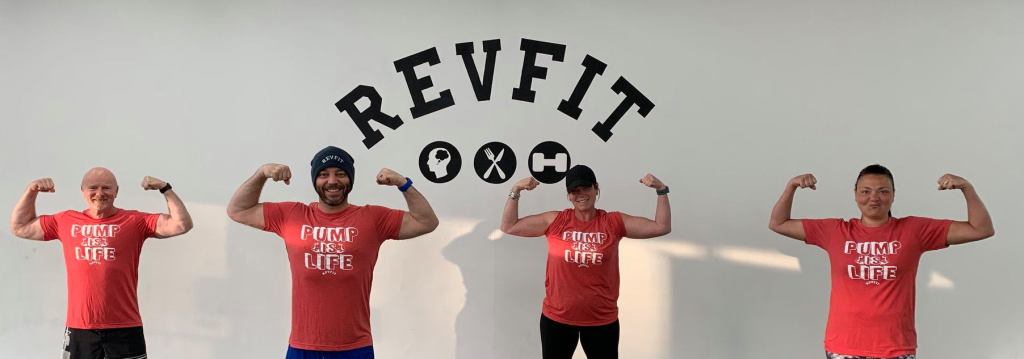
(Below is a recent shot of some of our socially distanced rockstars representing the newest line of our Rev swag in tribute to our Emily B. with a favorite saying of hers, “Pump Is Life”. Below is Bill, Shon, Amy and Cherie)
Kelly Coffey returns for her third time to the show (see episodes 72 and 137). Taking inspiration from a recent video she released to her audience, we dive into her take on the “three eater types”. We discuss the pandemic, the eater types and a better understanding of how and why to draw boundaries around our eating behaviors. This is a can’t miss episode. Download, subscribe, share with your friends and please take a moment to leave us an iTunes review.
I’ve always applauded my son Jackson for how he’s evolved with autism. Granted, it wasn’t done alone. It’s taken the help of a school focused on children with developmental disabilities and many hours and years of additional therapies to make even the smallest changes in his behaviors.
Ask any parent of a special needs child: it’s all worth it.
For those of us who wouldn’t consider ourselves on the autism spectrum, change still requires work. Change still requires discomfort. Change still requires that we be different. Different than we were before.
I’m not sure how well your health goals have fared over the last couple of months. Some of my clients actually did quite well as they methodically got closer to their physique goals. Some were happy to maintain their weight. Some gained more than they anticipated.
I’d say the last group comprised the majority of my clients, which by my definition, I call “normal”.
Now that the economy is gradually reopening for most around the domestic U.S., we’re starting to see clients transition back to some degree of the previous normal before the lockdowns began.
As most of us are making that transition back, it could be helpful to start asking more critical questions regarding how our health fared over the last two months.
I was speaking with one of my clients just this past week. His workouts have been more consistent and he feels like his diet has been mostly on point as well. The sticking point for him (as it is for many) is liquid calories. This particular client has a very stressful job with a lot of long hours. As a result, caffeine consumption is high during those shifts, courtesy of energy drinks, and when he’s not working, alcohol consumption increases.
He inquired about the effect of those energy drinks as a potential problem thwarting his weight loss efforts. I asked him how many calories were in those drinks.
“Zero”, he replied. “But what about the artificial sweeteners?”
I told him I wasn’t concerned about artificial sweeteners in the grand scheme of the diet. If you’d like some more insight on why I believe that, this is a great article for a reference point by Abby Langer, RD.
I told him, my biggest concern was the alcohol intake. I’m not asking my client to go dry. Just, find the places where he can reasonably reduce quantity and frequency and see how the scale behaves in accordance.
I joked with him though: “What’s the adage? Nothing changes if we don’t change…”
He laughed in agreement.
Another client has been struggling with using food as a coping mechanism for stress during the quarantine. Like me, she has a neurotypical child and a child with autism.
She’s got her own pre-existing health conditions and I asked her to start making a note of how she felt when she ate certain foods. Do specific foods make you feel bloated, gassy or lethargic? Take note. Find the trends. Remove the offenders (for the time being).
More pointedly, she’s been having a lot of physical discomfort lately. I asked her to find an area of her life/diet that provided the least resistance to change but the most potential benefit. Her response: I need to stop eating ice cream every day.
I’d call this a very easy solution to a potentially big issue. In her case, maybe she limits ice cream to once a week or she uses it as something of a small reward to herself when she’s gained weight loss momentum. It’s important to note that this is not a long-term or one size fits all solution. I asked her to consider what would make her feel best under the circumstances and to realize that this tactic could work great or not work at all. Anything is worth trying if it’s with the right mentality moving forward.
I bring up these examples because change is at the heart of all we do. It goes beyond fat loss and beyond body improvement. It’s about making decisions that make us feel empowered, it’s about building skills that promote our values and it’s about making incremental and/or significant steps towards our idea of a better/healthier self.
None of which can be realized without change.
None of which can be committed to without being different.
Like the changes and adaptations my fellow special needs parents recognize we need to make for our children, we have to consider that even those of us without special needs have to change something within ourselves if we want to see things improve.
Diet books don’t prepare you for these things.
No supplement can fix it either.
You may need the help of a coach, a support system and a fresh perspective on how your environment is affecting your dietary decisions. Yes, it could be as simple of a solution as “just cool it on the potato chips” but there’s normally something more brewing under the surface.
If you gained weight over quarantine, you are certainly forgiven. That weight, can easily be reversed (should that be a goal of yours).
Many of us saw sides of our lives and personalities we never realized we had until we experienced the last couple of months as they transpired.
Maybe the question I can leave you with to ask yourself is: How different are you willing to be to influence the change you’re wanting to make?
Now might be a good time to find out.
“We Make Great People Greater”
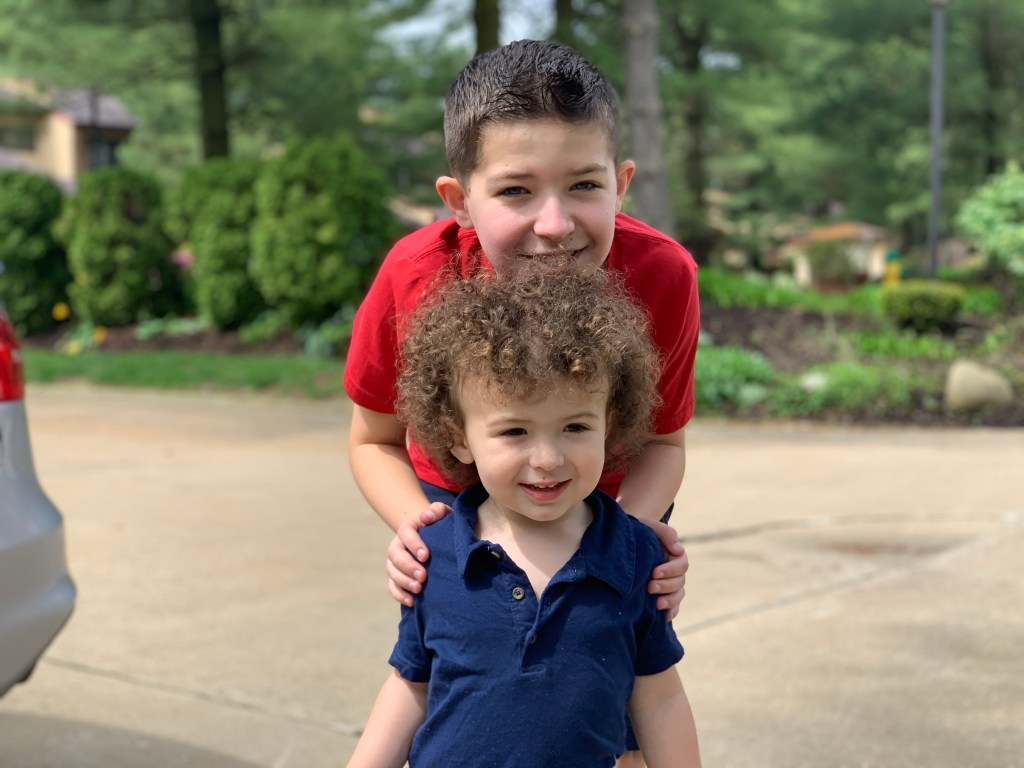
(Jackson, 12, below in the red hanging out with his little brother, Sebastian, 2).
I’m honored to welcome co-owner of Mark Fisher Fitness and Business For Unicorns, Michael Keeler, to his debut on the show. Mark was previously a guest back on episode #85 and it has taken me too long to get Michael on as well. This week, we discuss the evolution of MFF and the origins of Business For Unicorns as well as how they have adapted their business to the trying times with New York’s pandemic response. At the heart of this conversation is a focus on care for yourself and how you care for those you service. Download, subscribe, share with your friends and please take a moment to leave us an iTunes review.
When news of the Coronavirus first started having an effect on me, I was hearing about what was happening in other countries and I thought that maybe the U.S. wouldn’t be hit as hard.
I was wrong.
When I started hearing about how other states were affected by the virus, including lockdowns, business closures and depletion of grocery stock, I thought that maybe Ohio wouldn’t be as negatively impacted.
I was wrong.
Even when I heard that gyms were being asked to shut their doors, I considered the format of training, the amount of clientele in a fitness facility at one time, the inability to socially distance and I thought: “We’re not like other places. We can continue to operate within safe guidelines and remain open.”
I was wrong.
Sort of.
One thing I have always applauded the fitness industry for is a plethora of options. There are boot camps, CrossFit, Zumba, Yoga, family oriented fitness centers and more. Even within personal training, you have one-on-one, semi-private (our forte), and small group training.
There is a fitness option for every type of person and every type of motivation.
It always fascinated me how the more “competition” we saw as the rise of fitness options grew around me, the busier we got. I wasn’t upset that we had more competition, I was thrilled about it. Everyone (client and coach) was in a winning position. Every format had an opportunity to, as they say, have a slice of the pie.
Unfortunately, we all were forced to shut down.
Businesses which had never dreamed of making a name for themselves through online and virtual offerings now saw that the only way they could generate revenue was to fire up a Zoom meeting and keep business moving forward. For many, it worked. For many others, they’ll never be able to open their doors again.
When this article is released, we will be one week away from having the government green light to officially reopen our doors. That will mark about 10 weeks of a semi-operational business; a business that made a name for itself with almost solely a face-to-face presence that had to embrace the online world, with varied results, for those 10 weeks.
What will change for us?
Strangely (and happily), not much.
Long before I ever considered what living through a pandemic might feel like, our operations fell somewhat neatly into what the guidelines for safety would call for. Our facility has a little over 3000 square feet of operating space. While we do have an assortment of equipment, it’s rare that two people are side-by-side in a way that they can’t easily be six feet apart. Even at our busiest, we still have fewer than 10 people working on their individualized training plans.
There will be some housekeeping changes that will be in place for us: the state is encouraging all clients entering and leaving the facility to wash/sanitize their hands. There is also the encouragement to sanitize the equipment (benches, weights, attachments, etc.) immediately after use.
In addition, my staff and I are required to wear masks, wash/sanitize our hands, clean equipment behind our clients, and we may be required to perform temperature checks before shifts.
I have slated the scheduling of clients upon restarting to have no more than 3 people actively training at one time so we can keep the flow of workouts moving and prepare for the next incoming shift of 2-3 clients at the next training interval (approximately 30 minutes each).
We will also be temporarily removing our heavy bench press and squat work which would typically require having a spotter on hand for assistance.
In areas where equipment is spaced closer than six feet apart, our members will be encouraged to wait until space is available to appropriately distance themselves from others until the required equipment is safely ready for use. Fortunately, in our case, there is rarely an issue with this.
We will be installing touchless soap/sanitizer dispensers and touchless bathroom faucets to limit contact with items that might frequently require otherwise.
All in all, we’re ready.
We’re ready to get back to the business we love; training the people we love and root for day in and day out.
We’re ready to get our RevFit family back to the routines they’ve acclimated to, the programs they thrive on, and the community they haven’t seen in person since March.
And that begins again on May 26.
We look forward to having you be a part of it.
If we can’t control the world revolving around us, we can keep doing what it is we do best:



 Jason Leenaarts